

Guest post by Barb Boustead
In sharp contrast to the start of the Long Winter, the Ingalls family is preparing itself for the worst that winter can bring by harvesting and moving to town before any blizzards can catch them in the thin-walled claim shanty. The family collects staple crops – turnips, potatoes, carrots, beets, onions, tomatoes, and… ground cherries and husk tomatoes? Yep, I had to Google those, too. I had always had a pretty specific picture in my mind about what those fruits looked like when reading the books from my childhood onward, and I was pleasantly surprised that the real fruit resembles the one in my mind. The ground cherry is in the same family as the tomatillo and is related to the Cape gooseberry, and the fruits most commonly are used in preserves (as Ma used them), pies, or other desserts. In fact, the “husk tomatoes” described by Laura are indeed commonly known today as tomatillos. Tomatillos can range in color from yellow-green to reddish or purple when ripe, as Laura described, and are used in the same ways as classic red tomatoes. I have tasted jarred tomatoes, though I have to admit that I am curious about how “tomato preserves” would taste. Are they sweet? How did they eat the preserves?

Ground cherry in its husk and on its plant
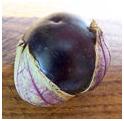
Purple tomatillo (husk tomato)
Pa and Laura both agree that the winter does not “feel” the same as the Long Winter, but it does not stop them from preparing for another winter like it. Pa moves abundant hay and straw to town, so that he will not be forced to risk being caught out in a blizzard to haul hay from the claim. The home in town must have seemed like it was bursting with food in comparison to the previous winter.
One weekday night, Laura is helping Ma pack clothing and stumbles upon a beautiful book of poems by Alfred, Lord Tennyson (who was a living poet in 1881, by the way!). She is drawn in by the beautiful, gold-embossed book and begins to read the first poem, “The Lotos-Eaters” (for what it’s worth, a “lotus-eater” is a person who gives in to pleasure-seeking). Midway through the eighth line, she stops abruptly, realizing that she has stumbled upon a Christmas gift for herself. In a stunning demonstration of willpower, she places the book back into the drawer without even finishing that line, guarding her guilty secret from Ma. Nancy Cleaveland has a great description of the possible actual book on her Pioneer Girl website at http://www.pioneergirl.com/index.htm?tennyson.htm&Bot_Frame, and the poem in its entirety can be found on several internet sites if one is inclined to spoil the surprise and read the whole poem!
Ma makes the winter home feel cozy, though Laura feels Mary’s absence in her empty rocking chair. Laura notes that the whole town, not just the Ingalls family, has hunkered down for the worst that winter can bring. The lumberyard has stocked up on fuel, and the merchants have stocked up on food and goods. The town would not be stretched to its limits by another hard winter, and the family feels safe and secure. After all the description of a relative abundance of food and rich presents, Laura ends the chapter with a note of concern: Carrie has not been healthy, especially since the Hard Winter. She is thin and weak, tires easily, and has frequent headaches. The move, and the shorter walk to school, will be good for Carrie’s health.