And One More on the Way: Barn Quilts | Beyond Little House

We continue our conference count down with information about something you might see anywhere along your route in the Midwest, barn quilts.


Barn Quilt


If you’re not from the Midwest, you might well ask just what is a barn quilt? In short, it’s a large plywood tile, painted as a quilt square and hung on the side of a barn (sometimes they paint them directly on the barn, but due to traditional barn battens they tend to look better on a second surface). The idea is too increase rural tourism by combining two things people in the Midwest often already love – barns and quilts. Although some people just hang the barn quilts on their own, most are part of a countywide program. You can just see them driving through the county or there is usually a map available giving you a route to drive to see all of them in a particular county. Some counties choose nice barns only. Some counties hang them on pole buildings or even put them on poles in front of a non-barn building. I even saw one once on the front side of barn where the back half of the structure had already collapsed, so they vary a lot.


I really think this would be an excellent program for the counties with Laura homesites to adopt. So far the only one I know about is Winnishiek County aka home of Burr Oak, Iowa. They started their program last year and there is even a barn quilt on poles outside the Masters Hotel. They need more participants, but kudos to them for starting.  I think  it would be a great idea for all Laura homesite counties because it would give fans an excuse to see more of the area and get a better feel for what it was like for Laura to live there and they can also be used to promote stops at rural businesses (many of which set up in farmsteads now made unnecessary as larger operations took over the farms). I think Laura fans would really enjoy it. What do you think?


Barn Quilt Beside Masters Hotel

Find a directory of current projects, lots more photos, and more explanation here.

Driving from Iowa City to the Burr Oak/Spring Valley/Pepin area you will see many counties that support these programs. This is just one I pass on the way that was nice and close to the road for a good clear picture. Please do remember that these barn quilts are on private property and take any photos from the road.

Also, they always photograph better if you can get the side of the building in full sun.

Sarah S. Uthoff blogs at TrundleBed Tales; look for her on Twitter and YouTube and Blog Talk Radio
Laura Ingalls Wilder Legacy and Research Association, Vice-President and Membership Chair

Posted in Homesites, Museums and Attractions, LauraPalooza 2012, Little House Travel Tagged with: , ,

These Happy Golden Years, Chapter 31: Wedding Plans | Beyond Little House

Mary’s back at college, and Ma and Laura get started on Laura’s sewing. Remember how awesome it was in Little Town when they made all of Mary’s new things for school? Now it’s Laura’s turn to be outfitted for a new life. Not just with clothes, but with linens, too—including those dreaded muslins that have to be sewn together into sheets, which is totally the Chore of Doom in Laura’s book, even worse than pulling up turnips.

Throughout the books she’s had to contend with all kinds of seam-sewing FAIL—everything from woefully inferior stitching skills (compared with Mary’s, which are tiny, and neat, and perfect, and ugh) to needle-through-the-thimble injuries (again, UGH). But this time Laura has a little something called The Industrial Revolution on her side. Now that there’s a sewing machine in the household, Laura realizes, she can just overlap the edges of the muslin and machine-stitch the whole business, can’t she?

Ma agrees, though she points out that “our grandmothers would turn in our graves.” What would the dead grandmothers be objecting to here? Were sheet seams such a simple task that it seemed absurd to do them by machine—like ridiculous overkill, like using a blender to beat an egg? Who knows. Still, Ma admits, “after all, these are modern times.” So Laura runs the sewing machine on the muslins and quickly dispenses with an old girlhood misery.

Then she turns to the “white sewing”— the pillowcases and underthings that need to be trimmed—and uses the machine to sew on the lace that she’s crocheted and knitted by hand. It’s a detail I never really noticed before but now appreciate, because it shows us just what kind of woman Laura’s decided to become.  I can’t help but think this is the same woman we’ll meet, years later, in the pages of the Missouri Ruralist columns and whose presence we can feel in the farmhouse in Mansfield. She has an electric stove in her kitchen but she won’t give up her old dash churn; she’ll gladly leave behind drudgery but understands the value and self-expression in the skills she learned from Ma—skills that she in turn passes on to Rose, who would go on write a definitive book on American needlework in the same decade she flew to Vietnam on assignment. I know, I’m going on, but it feels like so much is happening in those moments with the handmade lace and the flashing needle.

Together Ma and Laura decide that Laura needs only two new dresses, a nice black cashmere dress and then something pretty for the wedding. Meanwhile Almanzo is building their house on the tree claim, and Laura gets to see it under construction exactly once before it’s finished. “I’ll get a roof over it before the snow flies,” he says. (You’d better, Almanzo, because getting snowed on in bed is no fun. Just ask Pa.)

They all think they have several months to get ready for the wedding, until Almanzo drops by with this doozy: it turns out his sister Eliza has been making plans for them to have a big church wedding, and despite Almanzo’s objections, she’s got their mother set on the idea, too. Now he’s gotten a letter saying Eliza and Mother Wilder are heading out to De Smet to take charge of the wedding.  “Oh, no!” Laura says.

Oh, no is right. Supposedly she and Almanzo don’t want a big wedding because neither they nor Pa can really afford one, but I’m sure Laura is also wondering what kind of wedding good old Lazy-Lousy would plan for her. Will she loosen the bolts on all the church pews so that they rock during the ceremony? Give the bridesmaids slates to carry instead of flowers? The horror!

So Laura and Almanzo consider getting married sooner—like by the end of the week. If they do, Laura points out, she won’t have a wedding dress. Of course Almanzo thinks the calico dress she’s wearing is pretty enough for a wedding, because he’s sweet, and also, because he’s a guy.

But Laura has something else on her mind. “Do you want me to promise to obey you?” she asks Almanzo. Of course not, Almanzo says, since it “is only something that women say” in the standard ceremony but nobody ever expects to abide by it. What follows is this exchange:

“Well, I am not going to say I will obey you,” said Laura.
“Are you for woman’s rights, like Eliza?” Almanzo asked in surprise.
“No,” Laura replied. “I do not want to vote. But I can not make a promise that I will not keep, and, Almanzo, even if I tried, I do not think I could obey anybody against my better judgment.”

Oh yes, these lines. I think Laura’s refusal to obey says a lot of things here—that she’s got Pa’s spirit, that her experience growing up on the American frontier has taught her a lot about individual freedom (right, Rose?), and that times are changing.

Some people point this scene as evidence that Laura is a feminist. I don’t think she was—not in the way women who believed in woman’s suffrage in 1885 would have been. Unlike someone like Eliza, who worked for a time in Washington DC and was friends with controversial women like Dr. Mary Edwards Walker, Laura isn’t exactly bucking convention. She’s insisting on equality within her marriage, but not in the wider world. Really, she’s not even asking for much—all she wants is to omit a vow that “no decent man” would hold his wife to anyway, according to Almanzo.

And yet it’s precisely for that reason that her refusal to say “obey” is so very important.

As with the hand-knitted lace and the sewing machine, Laura is conscious of the ways the world is changing, and negotiating for herself what those changes mean to her. So even though her fiance claims that nobody takes the “obey” vows literally anymore and Reverend Brown doesn’t believe in saying them either, Laura still states her own terms. She’s a modern, self-determined woman in that she believes her actions are truly meaningful, whether it’s the things she makes with her hands or the words she says at her wedding ceremony, and a feminist I can admire and appreciate that.

I think I finally figured out why I’m such a stickler about whether or not to call Laura a feminist based on this scene. Because much like Laura with the word obey, the word feminist means something specific to me—the fight for certain rights (yes, including the right to vote.). The word can describe a lot of strong women I admire, but not all of them. I don’t need Laura Ingalls Wilder to be a feminist in order to be inspired by her, to love that she insists on marrying word with deed at the same time she’s marrying Almanzo.

With the “obey” issue out of the way, Laura and Almanzo decide to avoid a big wedding and to get married as soon as Almanzo finishes the house. But there’s one more war of words to be fought, and it involves Ma’s old sayings. Laura thinks Ma’s going to object to the quick ceremony with the “marry in haste, repent at leisure” line. But instead Ma trots out the “married in black, you’ll wish yourself back” saying, since the wedding dress hasn’t been made yet and only the black cashmere dress can be finished in time.

But Laura has an old saying of her own. She’ll wear “something old, something new, something borrowed, and something blue” by wearing the new black dress with her old blue-lined bonnet and Ma’s borrowed pin, making a nod to tradition in a way that suits her—again, like the modern woman she’s become.

It used to drive me nuts when Ma would finally give in and say, “I don’t suppose there’s truth in these old sayings” right after she just went and spouted off an old saying. But maybe the point is that Ma is wrong: there is truth in those old sayings when you give them meaning, as Laura is doing.

Still, Ma will be Ma, and her final bit of resistance is to insist that the ceremony with Reverend Brown take place at home. But Laura, who I imagine would love nothing more than to have a little wedding on the homestead, points out that they can’t, not without Almanzo’s mother there. Even a small wedding is a wedding, and Laura stands by her words.

It’s decided: she’ll be married in black, with hand-knitted lace-trimmed machine-sewn underthings. She won’t obey anyone against her better judgment—not her husband, not her in-laws. She won’t repent at leisure. She won’t wish herself back. It’s on.

Posted in These Happy Golden Years Tagged with: ,

These Happy Golden Years, Chapter 30: Sunset on the Hill | Beyond Little House

Guest post by Daniel Rabe

Mary’s summer visit is about over, she’s heading back to college on Monday. So this chapter is Sunday, and Laura decides to spend it with Mary, and not take the usual Sunday afternoon drive with Almanzo.

In the morning, they go to church with Pa, as Ma has decided to stay home with Carrie and Grace, for it is a hot day.  Of course Laura and Mary dress up for church, and Pa remarks that he is not “spruce enough to beau two such fine looking young ladies to church”.  The term “beau” is just not in vogue nowadays, but it was back then, and is quaint.

I find it interesting that often Laura tells of her feeling that Reverend Brown’s sermons are not at all interesting. One wonders what kind of content he used in his messages. Another church related comment by Laura is that when they could not find three places together, Pa sits with the graybeards in the “amen corner”. This says that in this church, it was alright for them to say “Amen” to an item in the sermon, although I don’t imagine it ever coming from Laura!

Laura does such a detailed job of always describing the dresses, and here she is again telling about hers and Mary’s dresses down to the smallest item.  We know that earlier she had described that hoops were in fashion in ladies dresses, and this becomes important as she relates an amusing incident in the service that morning, one which was more interesting than Reverend Brown’s message I’m sure!

A kitten wandered into church and after playing in the front near the pulpit, is chased by a dog! Apparently pets were not forbidden in this church! So the kitten finds refuge under Laura’s skirt, and begins to climb up the inner rings of her hoops! Laura stifles her laughter, but is silently shaking, and being hushed by Mary.  The kitten escapes,  not discovered by the dog, and after church Laura tells them the funny story, so that even reserved Mary had to smile.

I find it kind of fun to contrast the things about the church and compare to today. They had to dress up nice, when many churches now have gone to casual dress code. Some like Mary were very reserved, while Laura admits that she was never interested in Reverend Brown’s sermons, and as far as being behaved in church, was a “hopeless case”, finding amusement in the kitten. However, we do know that she always had to at least know the text of the message to report to Pa and prove she was listening.

In the late afternoon, Laura and Mary go for their walk, and it will be the last one, for Laura will be married before long. Mary is lamenting that things will not be the same, but Laura is trying to assure her that she will be able to visit Laura on Almanzo’s farm, where there will be trees, and sunsets.  Mary asks if Laura might put off her wedding until next June, and Laura, in a premonition to what happens, says “it will be just the ceremony, anyway”. How many young ladies now would be seeing their wedding that way? My thought is that Laura is viewing it through the lens of there  not being a wedding.  But Laura quickly tells Mary that she is ready to get married now, for she is 18, and is done teaching school, having done three terms, and wants to be settled in their own home. Besides, she had earlier said that she and Almanzo seem to “belong together”.  Now, when Laura wrote this book, remember that is was 60 years after the events, so she had all of those years to know that she and Almanzo did indeed belong together.

At this point, we can see that Laura is not looking back at the past as much as forward to the future. She closes this chapter by telling Mary that “maybe the times that are coming may be even better. You never know”.

Posted in These Happy Golden Years Tagged with: ,

These Happy Golden Years, Chapter 29: Summer Storm

Guest post by Barbara Mayes Boustead

Laura and Almanzo, accidental storm chasers!

I accidentally saw a tornado when I was 9 years old.  Our family was driving “up north” from the metro Detroit area into northern Michigan.  Somewhere just past Kensington, we saw a funnel cloud cross the interstate and touch down on the other side of the road.  It was probably a couple of miles in front of us, and I distinctly remember continuing to drive toward it while other cars were stopped.  I remember seeing pieces of trees that looked a little like broccoli being tossed in the air.  And then it rained, and my short and sweet tornado encounter was done, not to be repeated until I started chasing storms (on purpose!) in 1999.

I must have read this chapter ten times for every time I read These Happy Golden Years when I was a kid.  Tornadoes and Laura, together in one place!  Be still, my heart!

Stormy days on the Plains often begin on the hot and humid side.  By around midday, puffy cumulus clouds build in the sky – you know, the ones that look like piles of marshmallows and often form interesting shapes for those of us who lie down and watch them roll by.  As the afternoon passes, a couple of those cumulus clouds start to get taller than the rest, taller than they are wide.  In technical terms, those are “towering cumulus” clouds (yep, seriously!).  We meteorologists and storm chasers look for those towering clouds as a sign that thunderstorm development is imminent.  Sure enough, one of those towers starts to dominate the rest, growing tens of thousands of feet tall, with a back edge that looks like cauliflower.  The top flattens out, with the “icing” at the top (the anvil cloud) spreading downstream ahead of the thunderstorm.

In the heart of the storm, air is rising quite rapidly, and it usually is rotating at least slowly.  The most well-formed thunderstorms rotate more rapidly, and along that back edge, in a rain-free area, the base of the storm lowers.  This feature, called the “wall cloud”, is where most tornadoes are born.  A bystander watching the wall cloud literally will be able to see air rising and clouds swirling counter-clockwise.  Sometimes, a funnel cloud forms on the base of the wall cloud, pointing down toward the ground and spinning more rapidly than its wall cloud.  In some cases, that rotation reaches all the way from the base of the thunderstorm to the ground, and a tornado is born.  Scientists still don’t fully understand what makes some rotating thunderstorms produce tornadoes and not others, but some ingredients are a must:  Heat and humidity, which combine to create “instability”.  Winds that change direction and speed with height, known as “wind shear”.  Something in the atmosphere that triggers thunderstorm development, such as a front (cold, warm, stationary), a sea breeze, or even the air flowing out of another thunderstorm.
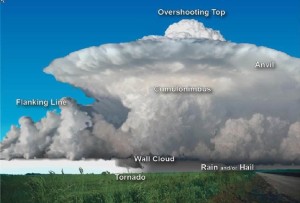
 

Diagram of a supercell thunderstorm. Image courtesy of NWS Omaha/Valley

Laura takes note of the heat and humidity very quickly on that summer day, August 28, 1884 – a Thursday, not a Sunday as she described in her book.  The wind blows in “hot puffs” – a gusty and warm wind, rather than a cooling and steady breeze.  On most stormy days in the Plains, the wind ahead of the storms will blow out of the south, southeast, or southwest.  Laura and Almanzo put up not only the buggy top, but a clever rain curtain that she describes in detail, as the clouds build.  Lightning shoots through and around the thunderstorm, and the kids have a sense that they’re in trouble.  (I’ll save my lightning safety soapbox for another day!)


Then, the trouble really starts, as a funnel forms and reaches the ground as a tornado.  Laura describes three funnels that take turns tearing at the ground.  As someone who has witnessed dozens of tornadoes, I am afraid to say that Laura has seen something that I never have!  It seems, based on her description and pictures from others, that she indeed witnessed three separate funnels that intermittently reached the ground, and not just one multiple-vortex tornado, the kind that has one large funnel but several fingers that spin around and reach for the ground at its bottom.  Almanzo estimates that the tornado is about 10 miles away, approaching them from the northwest as they race northeast ahead of it.  (He was probably pretty accurate there, actually!)  They are gambling that they will clear out of its path before it reaches them.
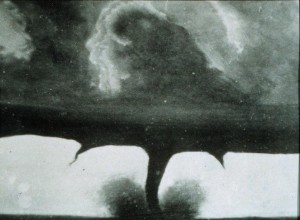
 

Often cited as the “first picture of a tornado”, this is actually the second known tornado picture. It was taken on August 28, 1884, by F.N. Robinson, from a street in Howard, SD. It is suspected that the photo has been retouched, as was common practice in the era, but it does seem likely that the depiction of multiple funnel clouds is accurate. Source: NOAA.
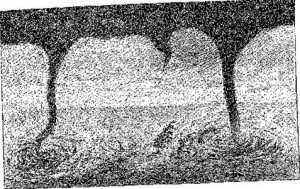


Sketch of tornadoes on August 28, 1884, near Redstone, SD (no longer a city, but formerly located 5 miles west of Carthage), by J.H. Nott. Source: Significant Tornadoes by Tom Grazulis, cited as a reproduction from the 1887 book Tornadoes by John P. Finley. This sketch provides additional evidence that this particular tornadic thunderstorm produced multiple funnels that intermittently touched the ground.

Let’s take a moment and discuss this move.  Given their situation, was that the best choice?  The answer is that given their options, it wasn’t bad.  The safest way to escape the path of a tornado is to figure out what direction it’s moving and then take a hard right and move away.  So, for example, if a tornado is moving from west to east, then turn south and go until you’re not it its path.  As long as you can keep the tornado in sight and then stay clear of it, and as long as your road doesn’t run out, this is actually relatively safe.  Laura and Almanzo took a left instead of a right.  This is more dangerous, because it puts them in the path of the hail that comes with a tornadic thunderstorm, but it still gets them out of the path of the tornado.

It works for Laura and Almanzo.  The tornado passes to their west, and they feel a cool breeze from the rain- and hail-cooled winds.  They return to Ma and Pa, and Pa and Almanzo set out to check on the neighbors.

From this point forward in the chapter, Laura may be telling stories that she heard, rather than things that she and Almanzo witnessed.  Still, the stories that Laura told were spot-on accurate, historically speaking.  Records indicate that indeed, two boys on mules were struck by the tornado, and one of those boys was killed.  The boys lived on a homestead that was destroyed by the tornado just northeast of Forestburg, SD.  (On the map below, Forestburg would be due west of Howard by 28 miles, right along the James River, near the beginning of the tornado track that crosses Sanborn and Hanson counties.)  Based on historical analysis of the damage to the boys’ farm, researchers assigned a rating of F4 to that particular tornado.  The story of the door sounds a little exaggerated, but it certainly is possible that the tornado lofted the door well into the atmosphere and that it didn’t fall back down until after the storm had passed.  Certainly tornadoes have been well known to move papers dozens or even hundreds of miles downstream and to loft relatively light debris high into the atmosphere.  The actual tornado path from this tornado was, at its closest, some 35-40 miles from DeSmet as the crow flies, which is a bit too long for an afternoon trip on a horse.  Perhaps Pa and Almanzo went to help on another day, or perhaps they helped with the Howard tornado aftermath (still about 22 miles from DeSmet at its closest point), or perhaps they didn’t go at all.
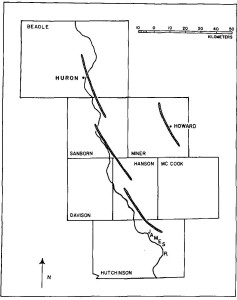
 

Map of the significant tornado tracks in eastern South Dakota on August 28, 1884. DeSmet is located due north of Howard and due west of Huron

Overall, on August 28, 1884, at least 5 significant tornadoes were documented in eastern South Dakota.  The tornado closest to Howard is the one in the picture and sketch above, and it is most likely the one spotted by Laura and Almanzo!  It was rated F2 based on the damage to a farmstead and barn, and it killed 30 cattle.  The fifth tornado, not on the map, occurred very near Sioux Falls.  Seven people are known to have killed by tornadoes that day.


Having a “feeling” about when stormy weather is developing is great, and often farmers and Plains dwellers have a pretty good idea about when the weather will turn turbulent.  For those who spend less time outside, or who are traveling through the Plains this summer (such as, say, in mid-July!), I strongly encourage you to travel with a NOAA weather radio.  Stay aware of forecasts, and please, I beg you, heed the tornado warnings when they are issued in your area.  Don’t wait until you can see the tornado.  Yes, many times, there isn’t a tornado at all, or the tornado misses you by miles.  But please don’t wait for that time when it gets too close for comfort.  It’s a small inconvenience to take shelter for a few minutes each year compared to the danger of leaving yourself and your loved ones vulnerable.  We have seen too many tragedies in these last couple of years, too many people who waited until the storm was too close or who didn’t heed the warnings because they thought it was “just another one”.  And definitely don’t wait until you can hear sirens.  Those are meant for outdoor warning only and are not intended (or able) to alert you in your home or wake you up.

I now return you to the safe Laura world, where feathers are sewn onto bonnets correctly!

Posted in Uncategorized Tagged with: ,

And One More on the Way: Phelps Park


Phelps Park Walkway


Here is  another in my series of postings of possible places you might want to add to your Wilder conference trip. Some will be Laura related, others are just kind of neat tourist spots. Enjoy!

Although probably not worth a side trip in itself, if you’re making the Burr Oak – Decorah, Iowa sidetrip (Read about it here) it’s worth your while to stop at Phelps Park in Decorah. If you find yourself in Decorah, take any street up the hill, away from the downtown area, and when you hit Jefferson Street, turn right. This will lead you to the very top of the hill and the park entrance. You will discover a city park constructed around 1900. The park has an unusual stone construction of things like band stands, gazebos, and covered walkways with the extra attraction of clinging to the top of a hill giving you a magnificent vista of the river valley below. Comprised of 56 acres along the hill top and down into the valley with prairie area below, it also offers several trails for walking or bike riding to stretch your legs before heading back to the car.

A two minute video shows some highlight images around the park and offers a more complex set of directions to find it.


Phelps Park Overlook


You can explore the area more with the surrounding Broadway—Phelps Park Historic District. It’s listed on the National Register of Historic Places, this neighborhood shows off examples of Midwestern architecture dating to 1850, including a home used for the underground railroad. Free self-guided tour maps available at the Decorah Area Chamber of Commerce.  

Here is a map of Decorah, with Phelps Park marked.

Sarah S. Uthoff blogs at TrundleBed Tales; look for her on Twitter and YouTube and Blog Talk Radio
Laura Ingalls Wilder Legacy and Research Association, Vice-President and Membership Chair

Posted in Uncategorized Tagged with: , , , ,

These Happy Golden Years, Chapter 28: The Cream-Colored Hat

This is one of my favorite chapters because it just feels as if things are going to be good from now on. I know. But this was back before I had read The First Four Years, or even knew it existed.

During these read-alongs, I enjoy reading each chapter summary because so many who cover a chapter often have a different take than I might have. And then the comments sometimes cover a whole different viewpoint on the same subject. I love it. It helps me to see things that I might never have picked up in my multiple re-reads of the Little House books.

When I started my own review, I felt like I was just writing all sunshine and flowers. To me, it was that good and happy and contented. But I’m pretty sure that some of you may see things a bit differently, so I’m going to ask…what do you think?

I’ve picked out a few of my favorite passages from Chapter 28 and I’d love to hear YOUR opinion! Follow along as I skitter about through the chapter:

She boarded at the Wilkins’, and they were all friendly to Laura and pleasant to each other. Florence still went to school and at night told Laura all the day’s happenings. Laura shared Florence’s room, and they spent the evenings cosily there with their books.

Laura’s last stint as schoolteacher and boarder certainly differed from her first.

On Laura’s weekend at home, she and Ma go shopping:

For Laura’s summer dress they bought ten yards of delicate pink lawn with small flowers and pale green leaves scattered over it. Then they went to Miss Bell’s to find a hat to go with the dress.

The dress. The hat.  I love Laura’s description of that cream-colored hat with those ostrich feathers and then, later on in the chapter, of the dress when it’s all done. Laura had the money to buy all of the things that she needed to start her life as a married woman and some left over to offer to her Ma.

What about that bulky object under a horse blanket in the back of the wagon?

“Now whatever can that be?” Ma said to Laura. They waited. As soon as possible, Pa came hurrying back. He lifted the blanket away, and there stood a shining new sewing machine.

The moment, the very moment, that I read this passage I knew that I had to have a treadle sewing machine. It took about 30 years, give or take, but I finally did get mine; a surprise from my daughter.

And then, when Laura has money to spare, I chose to look at it as a daughter who is happy to help her parents out when she is able to and after they have done so much for her. I’m not sure everyone would share my view:

Ma yielded. “If it will please you to do so, give the money to your Pa. Since he spent the cow money for the sewing machine, he will be glad to have it, I know.”

Laura rides away with Almanzo on Sunday, her heart was brimming with contentment. That’s the way this whole chapter makes me feel.

The following Friday, Prince and Lady couldn’t take Laura home quickly enough because:

Mary was even more beautiful than ever. Laura would never grow tired of looking at her. And now there was so much to tell each other that they talked every moment. Sunday afternoon they walked once more to the top of the low hill beyond the stable, and Laura picked wild roses to fill Mary’s arms.

And they talk about “that Wilder boy” and moving away and growing up.

When Almanzo picks Laura up from the Wilkins after the school term is finished and points out that it is the last time ever (that she will be a schoolteacher), she wonders:

“Are you sure?” Laura replied demurely.
“Aren’t we?” he asked. “You will be frying my breakfast pancakes sometime along the last of September.”

Almanzo had already begun to build a little house on the tree claim. Their little house.

Laura and Almanzo decide to take Barnum and Skip out for a drive on the Fourth of July. The horses are due for a workout.

So on the Fourth, soon after dinner, Laura put on her new lawn dress for the first time, and for the first time she wore the cream-colored hat with the shaded ostrich tips. She was ready when Almanzo came.

You knew a hat worthy of having a whole chapter named for it had to make another appearance, didn’t you? And so the prairie wind almost claims those ostrich feathers, but Laura is able to save them at the last second. They are safely in Almanzo’s pocket for safekeeping. I don’t know why this small act caused me to feel more familiarity between Almanzo and Laura. Like they were more comfortable together, transitioning to their roles as husband and wife.

And the chapter ends with:

The feathers were still in his pocket, and as he handed them to her at home he said, “I will be by for you Sunday. These horses do need exercise.”

Of course those horses need exercise!

Posted in Uncategorized Tagged with: ,

And One More on the Way: Lincoln Highway

We continue our conference countdown with the Lincoln Highway.

Lincoln Highway Bridge

I’ve lived most of my life on one side or the other of Highway 30 which for most of its route follows what was once the Lincoln Highway, so it’s always a surprise to me when people haven’t heard of it. After all it stretches across the country from New York to California, but there are those who’ve never come across it.

The Lincoln Highway was the first paved road across the country. First it was just a route, then a few seedling miles of cement (one just outside of Mt. Vernon, Iowa near where I live), but it was the main way to get across the country for decades until a new system of naming highways turned route names with personality and cool symbols into a set of numbers  as part of the newly nationalized system. ( For instance, if you’ve researched at the Hoover Presidential Library you will have driven on what used to be the old Herbert Hoover Highway – with its 3 H logo and maybe on the Red Ball Route with its logo like a Japanese flag, they really were fun.) When it became clear that the name Lincoln Highway would be lost, in a national effort ,Boy Scouts marked the route with cement posts topped with a massive Lincoln Penny like coin the size of your fist to memorialize it. Most are either missing altogether or removed to museums, but sometimes you will still come across one in it’s original location. Today as you make your way throughout the Midwest you often find a town or a county that has in someway marked their local piece of the highway. My favorite way is when they repaint the telephone poles with the red,

Lincoln Highway Cement Marker

white, and blue bands as they originally did. Much more frequently you see signs and cloth banners declaring the path of the Lincoln Highway and street and store names declaring the connection. This video provides an excellent introduction on the road, why it is important, and how it changed driving.

This Highway, Dedicated to Abraham Lincoln

Find much more information about the Lincoln Highway in Iowa and some more Lincoln Highway signs complete with some of the signs you might see as you’re driving along the route.

The Henry Ford Museum posted this lovely little 2 minute video,Fording the Lincoln Highway,  with the highlights of a trip the 10 millionth Model T took driving across the country in a caravan on the Lincoln Highway. It was a silent movie and the text screens have been cut way too short, but the text from all of them appears the information about section below the video when you watch it on YouTube. You may want to pause and read them.

And the next time you’re out driving keep a look out for signs, markers, businesses, or even painted telephone poles to tell you that you are on the Lincoln Highway. (A good part of the former route, not all is incorporated by modern Highway 30 which might help you find some of it.)

Sarah S. Uthoff blogs at TrundleBed Tales; look for her on Twitter and YouTube and Blog Talk Radio
Laura Ingalls Wilder Legacy and Research Association, Vice-President and Membership Chair

Posted in Uncategorized Tagged with: , , , ,

Social Media at LauraPalooza | Beyond Little House

We have been very supportive of using social media and hope that you will participate in LauraPalooza via social media whether you can attend or not.

  • Find us on Twitter. Follow or tag us in at @BeyondLitlHouse and use the hashtag #LIW12.
  • Like us on Facebook also join the group for the conference, LauraPalooza 2012.
  • We don’t have a YouTube Channel, but look for my video diaries of the conference on my Trundlebed Tales channel.
  • Plus we just created a LinkedIn Group for Laura Ingalls Wilder Legacy and Research Association. There won’t be too much live conference stuff on there, but if you’re on LinkedIn, please join us.

Sarah S. Uthoff blogs at TrundleBed Tales; look for her on Twitter and YouTube and Blog Talk Radio
Laura Ingalls Wilder Legacy and Research Association, Vice-President and Membership Chair

Posted in Administrivia, LauraPalooza 2012 Tagged with: , , , , ,

And One More on the Way: Cassville Ferry | Beyond Little House

Cassville Ferry


As part of our conference countdown, I’m adding another to the series of postings of possible places you might want to add to your Wilder conference trip. Some will be Laura related, others are just kind of neat tourist spots. Enjoy!

The Ingalls Family were often traveling through areas where there aren’t any bridges. They crossed rivers by ferry. You can too. Much safer than driving across the frozen river, the Cassville Ferry runs from Cassville , Wisconsin, to Millville, Iowa, across the Mississippi River. It connects two National Scenic Byways; the Great River Road in Wisconsin (which eventually goes to Pepin) and the Iowa Great River Road. Ferries serviced the area as far back as 1833 and this particular ferry is the oldest operating car ferry in Wisconsin. This small car ferry gives you a good feeling of what it would be like to take your covered wagon across a river ferry with other travelers. It’s really a memorable experience and a great way to get an up close look at the Mississippi River.
Find more information on their website. Or watch one family’s video of the ferry.

And, in case you’re wondering, the photo is from our family trip awhile ago. That’s me on the left and my grandmother on the right.

Sarah S. Uthoff blogs at TrundleBed Tales; look for her on Twitter and YouTube and Blog Talk Radio
Laura Ingalls Wilder Legacy and Research Association, Vice-President and Membership Chair

Posted in LauraPalooza 2012, Little House Travel Tagged with: , ,

Volunteers Needed! | Beyond Little House

We are less than a month away from LauraPalooza! Yay!

We’ve been working on the last few details and we want to open up a few opportunities for attendees to get more involved. Primarily we are looking for people who would be willing to MC a section. The submitted papers have been divided into groups of similar topics. MCs will introduce the speakers for their group and act as a time keeper for that section making sure presentations stay on schedule. We have several of these positions open.

If you’d be interested in helping, but public speaking isn’t your thing, we have a few behind the scenes tasks available too, so if you’re interested either way, please e-mail us at:  [email protected]

Posted in Administrivia, Announcements, LauraPalooza 2012 Tagged with: , ,