The Haders’ Little House

Big Snow Cover

Big Snow

When I tell people about Berta and Elmer Hader, I ask if they know the Haders’s Caldecott Medal winning book The Big Snow. Sadly many people haven’t read this delightful book. I then ask if they remember the news reel footage from the beginning of the Rudolph the Red Nosed Reindeer Christmas special. That they usually know. The Big Snow is a picture book about that same real blizzard that buried New York City and is probably the Haders’s best known book in a long career that featured children’s books they wrote and illustrated and a series of widely popular paper dolls.

Before the Haders were married, Berta was roommates with Rose. Laura called her “the little artist girl.” The Haders maintained a lifelong friendship with Rose. Elmer painted a picture of Telegraph Hill that he gifted to Rose and is now on display at the Laura Ingalls Wilder Home & Museum in Mansfield, Missouri. When Laura’s first autobiographical manuscript, Pioneer Girl, was rejected, it was Berta who suggested it might fare better as a children’s book. This led to the manuscript being re-written as a picture book. This as yet unpublished picture book was called When Grandma Was a Little Girl. It was this that Knopf asked Laura to extend into the chapter book that eventually became  Little House in the Big Woods.

Berta and Elemer Hader

Berta and Elemer Hader

Today the Haders have started to fade into obscurity. Now some of their relatives are trying to reverse that trend. Read all about the Haders and see examples of their work here.

Please look for some of their books. I personally recommend The Big Snow and The Stone House. The Stone House tells the story of them building their dream house slowly, doing much of the work themselves. It’s a great story. Today the house still stands, but has been remodeled beyond recognition. Rose was a guest here. In any of the Hader books look for their delightful signature self-portraits which are different in each book.

Sarah S. Uthoff, Trundlebed Tales

Posted in Uncategorized Tagged with: , , , , , , ,

The Long Winter, Chapter 4: October Blizzard

At first you might think that this is just another one of those mornings where Laura wakes up to Pa’s trouble song while her bed’s covered in snow. (Remember that time in By the Shores of Silver Lake?) All right, to be fair, it’s just some ice on the quilt, and at least the house has a roof this time. But something else is different this time around, something about Pa’s sunflower song:

“Oh I am happy as a big sunflower (Slap! Slap!) That nods and bends in the breezes, Oh! (Slap! Slap!) And my heart (Slap!) is as light (Slap!) as the wind that blows (Slap! Slap!)”

I don’t think it diminishes the terror and absurdity of the situation one bit to say that this is hilarious. Because how else can you possibly respond to an October blizzard?  Besides getting dressed while your teeth are chattering and noticing that the snow has blown under the door, that is, which is what Laura does.

And then there’s this from Ma: “A b-b-b-b-blizzard!” Ma chattered. “In Oc-October I n-n-never heard of…”

For me this is one of the most indelible bits of Little House dialogue, one of the linchpins of my memory of this book. Without it maybe I could’ve vaguely recalled that the first big heap of the Heap Big Snow fell way too early, but thanks to Ma, I will forever remember that it happened in Oc-October.

The rest of the family gets up and gets dressed, and for a little bit things feel too hurried to dwell to much on grim details like the frost on the nails in the walls and the way Laura has to use the snow on the floor for the wash-basin. (Oh, but there will be plenty of time for that later!) Pa somehow manages to go out in the blur of snow and cold to do his chores and then bring in wood after breakfast.

Whatever they have for breakfast (bread?) isn’t as important as The Beans, which Ma had the foresight to soak the night before. And I ask you: has ever a single pot of beans done so much as this one? It’s dinner, supper, a steamy heat source, and an extremely comforting aromatherapy device. Pa says, “There’s nothing like good hot bean soup on a cold day.” Oh, Beans, you had me at “HOT.”

Never mind that in The Little House Cookbook, Barbara Walker quite sensibly points out that the bean soup that sounds so wonderful here is really just the simmered broth from the cooking process. “How good a soup it is depends on how cold you are, and how hungry,” she says. In other words, the wonder of The Beans is best left to the imagination.

Note: real cambric tea is lighter than this.

I did, however, just try Walker’s instructions for the cambric tea Ma gives to Grace.  Indeed it’s just “hot water and milk, with only a taste of tea in it,” as the book says. (Sadly, as I am an adult, it did not have enough tea in it for me, but never mind.) Walker mentions that “temperance crusaders deplored cambric tea as a way of introducing stimulants to the young,” but, as we’ll see, every now and then a kid can be overstimulated for her own good.

Anyway, it’s just like the Ingalls to make a cold day spent in a drafty shanty sipping tea and bean-water seem perfectly cozy. Pa tells Carrie and Grace the same stories that he used to tell Laura and Mary in the Big Woods (one bit I love: that he calls Grace “Blue-Eyes” the same way he called Laura “Half-Pint”), and later gets out his fiddle. But just the same way as the cold creeps in at the corners of the shanty, we’re always aware that things are dire—that it’s so cold that the snow that blows in from outside doesn’t melt, and that Ma is perhaps one mournful fiddle song from losing it.

But as it happens, Grace gets antsy and impatient in Ma’s lap (ha, guess why?!), and when she insists on running around she inspires Pa to get Laura and Carrie out of their seats and stomping around the shanty to Scottish marching songs. “They felt that banners were blowing above them,” the book says, “and that they were marching to victory.”  With this kind of energy and inspiration on their side, for a moment we’re sure it’s going to be another All’s Well that Ends Well situation.

Except, well, it doesn’t end: in the morning Pa is singing his sunflower song again, and the blizzard continues—two more long days and two more nights.  And though the book never gives the details of those two days, we can only guess that it must have consisted of more beans, more tea, more marching. Whatever it takes.

***

Previous chapters: 1: Make Hay While the Sun Shines, 2: An Errand to Town. 3: The Fall of the Year. To cover a chapter in this read-along, find out more here!

Posted in Uncategorized Tagged with: ,

Blizzard Warnings in Minnesota–Again

Right now, I feel a good deal like Florence Garland did in 1880:

“Miss Garland was thinking and biting her lip. She could not decide to dismiss school because of a storm, but this storm frightened her.

“‘I ought to tell her what to do,’ Laura thought. But she could not think what to do. It was not safe to leave the schoolhouse and it was not safe to stay there. Even the twelve patent desks might not last long enough to keep them warm until the blizzard ended.”

p. 85, The Long Winter

And so, today, I can still see across the street, as of right now. But the winds are picking up, the snow is coming, and K-12 schools across the state, gifted with weather radar, have cancelled classes beginning at noon today.

MSU, as a university, has not  yet made the move to cancel classes. And so, as I teach all afternoon, what is it I do?

I go back to the trope of independence, of course. I live six blocks from here, and I can make it home safely this afternoon. Some of my students, commuters, might have an hour or more to drive. I put the decision in their hands, blessing the modern technology that allows me to shoot an email to all of them simultaneously.

There are no penalties for unexcused absences today, I wrote. I’m here, and I’ll hold class for those who also are here.  But use your own judgment, and I’ll see the lot of you on Wednesday.

My great hope? I don’t need a rope and a lantern to make it safely home.

Posted in Uncategorized Tagged with: ,

The T-shirts Are IN

…And they look FABULOUS. Check it out:

Front and Back views of the LIWLRA T-shirts

Front and Back views of the LIWLRA T-shirts

There’s still plenty of time to order yours! (That’s my untidy office bookshelf in the background.)

Posted in Uncategorized Tagged with: ,

The Long Winter, Chapter 3: The Fall of the Year

As this chapter begins, the weather machinations are clicking along: the hot September days of haying end abruptly with three days of rain, and then, after that, the first frost.

“My goodness,” Ma said shivering, while she laid kindling in the stove. “And this is only the first day of October.”

The more I read the Little House books, the more I notice that Ma is kind of like a Greek chorus in a wool shawl. Ma will always tell you what’s going on and whether or not you should worry. (Usually you should, unless it’s all well that ends well.)

Laura goes out to get water from the well, and looks out at the frost, which is both breathtaking and deadly, and gorgeously described.  It’s a brief moment, I know, but it’s one of dozens that make The Long Winter really a Little House book, and not just a story about the Hard Winter of 1880-1881. Lots of other people could write about that winter, complete with its heroic themes about the triumph of the human spirit against the elements and blah blah. But I love that the familiar refrain of the seasons is still played.

Pa announces that it’s time to get in the harvest, though there won’t be much of it this first year. The yield is: five bushels of potatoes, a gallon of canned tomatoes, two quarts of green tomato pickle, “lots of turnips,” whatever that means, early a bushel of beans, six ripe pumpkins, and, well, some corn. Pa jokes that it’ll probably be a teacup’s worth. Laura seems to think it’ll be enough food for them with Pa’s hunting. We’ll find out soon enough that she’s counted her chickens before they’re hatched (or, really, her geese before they’re shot).

Side note: has anyone ever eaten a raw turnip? I tried this summer, and I guess it’s an acquired taste. To me it was like biting into a giant pencil eraser, a bitter eraser with top notes of wet shoe and sadness. But I did it because of this line, which appears in this chapter: “Carrie loved to eat a raw turnip.” Aw, Carrie. She’s shy and sensitive but she’s still a frontier kid with her turnip-eatin’ ways. And I love that line.

All throughout the harvest Pa is rushing around, making sure that the corn is cut and the pumpkins are brought in (“I feel in a hurry. As if there was need to hurry,” Pa said tried to explain.   I used to think that this was just Pa’s instinct, the muskrat part of his brain kicking in. But when I went back and re-read By the Shores of Silver Lake recently, I noticed all the famous-last-words sort of things he’d say about the winter weather in this new place. Why, it won’t be like Minnesota! Three degrees west is as good as one degree south! At the New Year’s dinner in the surveyor’s house, he says, “If this is a sample of a Dakota winter, we’re all lucky we came west.”  Oh, Pa. Now I can’t help but think that ever since he laid eyes on that muskrat house, the wheels have been turning in his head.
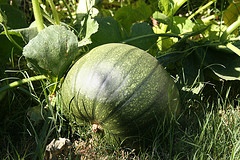
Green pumpkin!

Anyway, he goes off to shoot some geese, and while he’s gone Ma gets the notion to make a pie with one of the green pumpkins left in the garden from the frost and surprise Pa with it. And here we must briefly diverge for a few items of PIE TALK because, well, we are compelled:

  1. According to my haphazard web research, it’s possible Ma based her idea on mock apple pie recipes devised by westward-bound pioneers who used soda crackers. (This article suggests that the recipe originated in the 1850s.) Much later, the mock apple pie recipe on the Ritz Crackers box would become popular in the 1930s and 1940s—some accounts say that it was because apples were expensive during the Depression, others say that they were rationed during WWII.  Either way, it’s likely that when The Long Winter first came out, readers would’ve found something familiar about Ma’s clever pie hack.
  2. In her green pumpkin pie recipe in The Little House Cookbook, Barbara Walker admits if you don’t grow your own pumpkins it’s a little tricky to score an unripe one. This fall I’d tried asking around my city farmer’s market, but found I was about a week too late. I did find several market vendors who would’ve let me special-order one had the timing worked out, so maybe next fall I’ll try.
  3. This blogger made a green pumpkin pie and reports her somewhat mixed results, though there are some handy tips in the comments.

Okay, so the pie’s in the oven. In the meantime, there’s a few more excellent Ingalls family moments. In just a few lines here and there we get a really nuanced portrait of who Laura is at 13: impulsive enough to try to “dodge between the raindrops” instead of wearing a shawl when she runs out to get the pumpkin from the field, but restrained enough (barely!) to keep from “flying to pieces” during the hated sheet-sewing chore.

I won’t even go into the unspoken bitterness that comes with sheet-sewing, at least some of which is caught up in the fact that the one person who could stand to sew those horrible seams it is now blind, and thus gets to knit instead and give totally unhelpful answers to hypothetical questions like why can’t sheets be made wide enough? Which really is just another way of asking why muslin has to be so stupid and narrow, Mary, so shut up!

(Okay, so I did go into the unspoken bitterness.)

And then, then, Laura’s needle slips through a hole in the thimble and sticks her in the finger! Oh my turnips, this stuff made me so glad I wasn’t a teenage girl in 1880 because I wouldn’t have been able to keep quiet the way Laura did. But of course, all this helps give us a sense of how Laura will evolve through the winter.

Pa doesn’t return from hunting in time for dinner, but he finally shows up for supper empty-handed (except for his gun) with sobering news: “Not a goose or duck on the lake,” he says. No other kind of game, either: “Every living thing that runs or swims is hidden away somewhere. I never saw country so empty and still.” I’m only quoting a little here, but Pa’s entire speech at this juncture is really worth reading aloud.

But there’s still the pie, which comes as enough of a surprise to Pa to stir him out of his deep worry.  He even thinks it’s apple pie, until Carrie gets to announce: “It’s pumpkin! Ma made it out of green pumpkin!” Happiness ensues. Pie saves the day!

But lest we think the threat of the worst winter ever has simply been forgotten, the family eats the pie slowly, trying to make it last. It’s a very Little House way of indicating foreboding.  “That was such a happy supper that Laura wanted it never to end,” the book says, and when the supper ends, Laura stays awake in bed to prolong the happiness. All is warm and cozy, except for that drip of water on her face as she drifts off to sleep. Oh, but never mind! Everything is wonderful. Something’s not right.

***

For further reading (and eating): This zucchini pie recipe uses the same basic principles that Ma’s pie did, so if you want to try something similar without having to wait for another pumpkin crop, this might be worth a shot!

Catch up on past chapters: 1: Make Hay While the Sun Shines, 2: An Errand to Town. Want to cover a chapter in this read-along? Find out more here!


Posted in Uncategorized Tagged with: ,

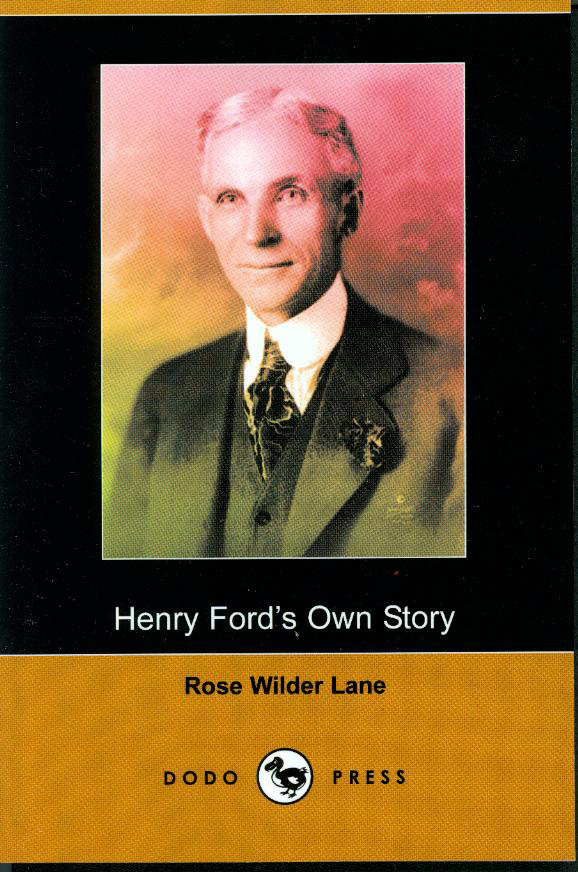
Republished: Henry Ford’s Own Story by Rose Wilder Lane

Henry Ford's Own Story

Henry Ford's Own Story

Most of Rose’s books came out before the magic year where copyrighted books currently pass into public domain. Several publishing companies have taken to reprinting these books. They don’t have to pay anything for the text, so except for the costs of actual book production, the entire price of the book is profit. I wrote previously on the Trundlebed Tales blog about copies of re-printed copies I purchased of The Making of Herbert Hoover and Diverging Roads, both by Rose Wilder Lane. These re-printed books were scanned from original copies; pages were  simply printed from the scans and bound as a book.

Now, I’ve found another book re-printed in a slightly different manner. It’s produced by a different company called Dodo Press. Unlike those, this version of Henry Ford’s Own Story by Rose Wilder Lane was clearly re-typed. It doesn’t include any extras, like a table of contents. It’s just the title page and the text block. The book design isn’t the greatest, but the text is large and clear. Dodo says their mission is: “Where books are no longer in print or poorly available we are seeking to make them available again by republishing, we do this through 2 Imprints called Dodo Press and Asio Press.”

You can read more about their books on this website.

Besides Dodo’s own books, they also sell reprints and originals by other companies including other titles by and about Rose. I’ve only purchased the one copy from them, but I had no problems with the order.

Sarah S. Uthoff, Trundlebed Tales

Posted in Uncategorized Tagged with: , , , , , , ,

Republished: Henry Ford’s Own Story by Rose Wilder Lane | Beyond Little House

Henry Ford's Own Story

Henry Ford's Own Story

Most of Rose’s books came out before the magic year where copyrighted books currently pass into public domain. Several publishing companies have taken to reprinting these books. They don’t have to pay anything for the text, so except for the costs of actual book production, the entire price of the book is profit. I wrote previously on the Trundlebed Tales blog about copies of re-printed copies I purchased of The Making of Herbert Hoover and Diverging Roads, both by Rose Wilder Lane. These re-printed books were scanned from original copies; pages were  simply printed from the scans and bound as a book.

Now, I’ve found another book re-printed in a slightly different manner. It’s produced by a different company called Dodo Press. Unlike those, this version of Henry Ford’s Own Story by Rose Wilder Lane was clearly re-typed. It doesn’t include any extras, like a table of contents. It’s just the title page and the text block. The book design isn’t the greatest, but the text is large and clear. Dodo says their mission is: “Where books are no longer in print or poorly available we are seeking to make them available again by republishing, we do this through 2 Imprints called Dodo Press and Asio Press.”

You can read more about their books on this website.

Besides Dodo’s own books, they also sell reprints and originals by other companies including other titles by and about Rose. I’ve only purchased the one copy from them, but I had no problems with the order.

Sarah S. Uthoff, Trundlebed Tales

Posted in Uncategorized, Writings and Works Tagged with: , , , , ,

Long Winter Chapter 2: “An Errand To Town”

My heart’s a-flutter. For in this chapter, our heroine meets her hero for the first time, and sighs of delight echo across the prairies from romantic young (and old?) readers.

At the opening of our scene, it’s still hot. Even in September, Pa works steadily to cut hay, thinking ahead to spring when some of it might be sold for extra income. But there’s surprise here, as a light September frost overtakes the prairie, and Pa seems to work with doubled speed.

So the momentary pause of a broken tooth on his new mower machine, which once might have encouraged the gregarious Ingalls patriarch to go to town, prompts Pa to ask Laura to go instead. As far as we can tell, as readers, this is the first time Laura has been trusted to go town by herself on an important errand.

She rushes to the house, where Ma puts the kibosh on her borrowing Mary’s fresh bonnet. Laura’s own bonnet would be fresher, Ma cautions, if she took better care of it. But she allows Laura to change to a clean dress and gives Carrie permission to keep Laura company on the walk.

It’s a nice scene, as Laura and Carrie follow the wagon tracks into De Smet, talking along the way, but going silent as they reach Main Street. They go into Fuller’s Hardware, ask Mr. Fuller for the mowing machine section, pay for it, and leave, still silent, until they get back out of town.

There we discover the pair of them both suffer from shyness, which isn’t surprising given their general lack of association with any other than their own families. Still, Laura and Carrie are feeling very grown up, talking as sisters, walking home, when they decide to take a shortcut through the slough.

Oops. Bad idea.

At first, Laura writes,  it seemed fun. The tall slough grasses, which overshadowed them, seemed like the jungle in Pa’s big green book. But it’s not long before they realize they’re lost. They know that this could be critical; it’s VERY easy to get lost in the slough, and never be found again.

(Having seen the slough at the Homestead, I agree–it’s a scary, deceptive place. I completely understand how easy it could have been to get lost.)

They stumble around for awhile, agreeing that there was nothing else to do but go on, when they start to hear male voices coming from a clearing. They walk into a cleared space in which a “man” and a “boy” are working. The boy is on top of the hay wagon, giving his brother a hard time. But it’s clear that the boy works hard from his sunburnt skin. He had black hair and blue eyes, and they twinkled at Laura as if he “had known her for a long time.”

In fact, what’s notable about this scene is the subtext that shows that Almanzo Wilder is intrigued by his new neighbor. “He was still looking at her,” she writes. And she recognizes the horses, gleaming and beautiful, as the Wilder boys’ horses. So these, she thinks, must be the Wilder brothers.

Almanzo points out the direction in which he can see Pa mowing, and Laura thanks him. She and Carrie speed off in that direction, find Pa, give him the mower section, then head for the house.

They’ve learned one other thing about sisters: Sisters can band together. “Are you going to tell Ma and Pa?” that they got lost, Carrie asks. Laura replies, “We have to if they ask us.”

Which means they’ve also learned that as grown-ups, sometimes it’s better to keep things to themselves.

Posted in Uncategorized Tagged with:

Happy Laura Ingalls Wilder Day!

What? You hadn’t heard?

That’s right, today is officially “Laura Ingalls Wilder Day” in the state of Wisconsin, as proclaimed by its governor, Jim Doyle. The proclamation was presented at 1 pm today by Lt. Governor Barbara Lawton at the Overture Center of the Arts in Madison, Wisconsin, where Little House on the Prairie: The Musical begins its six-day run. (Laura’s cousin Beth Ingalls-Leisses will be in attendance at one of these performances.)

For further reading viewing:

Laura Ingalls Wilder Elementary School in Green Bay, Wisconsin, celebrates LIW Day

Good Day Wisconsin showcases Wilder-related books

Posted in Uncategorized Tagged with: ,

Little House in Court: What Happened?

Little House on the Prairie

The Little House on the Prairie site

In the fall of 2008, the Little House on the Prairie homesite near Independence, Kansas, made national headlines due to a lawsuit filed against them by Friendly Family Productions, who own the rights to the Little House on the Prairie television series. But since that time, there’s been no mention of where things stood as far as this lawsuit was concerned.

Now it seems an agreement has been reached, although the terms of that agreement will not be officially released until sometime next month. The good news is that owner Bill Kurtis doesn’t anticipate that there will be any significant changes to the way the museum is run.

For further reading:

Ask the Experts: How Can a Book Title Be Copyrighted?

Posted in Uncategorized Tagged with: , , ,