Sloo and Slough

When I was in De Smet this summer, we were talking about the Big Slough and as always a quote from Emily of Deep Valley popped into my head. Other people in the conference planning group said they had the same thing happen to them. It’s so nice to be with people who understand you. I hope all our readers get that chance at the conference this summer.

Oh, and the other thing the quote makes pop into my head is Cherry Jones reading Farmer Boy. Jones, clearly not a farm girl, says hay mow (rhymed with row) instead of hay mow (rhymes with now). Every time I listen to it, I spend the whole time automatically correcting her. Now you can too. ;-)

Lovelace, Maud Hart. Emily of Deep Valley. New York: Harper Trophy, 2000. ISBN 0064408582

“The Deep Valley slough, pronounced sloo, was the marshy inlet of a river. When Emily had first read Pilgrim’s Progress, after finding it mentioned in Louisa M. Alcott’s Little Women, she had pronounced the Slough of Despond sloo, too. She had called it sloo until Miss Fowler had told her in English class that Bunyan’s Slough rhymed with “how.” Miss Fowler had made the correction in a casual unembarrassing way, putting her emphasis on the fact that Emily alone, out of the class, had read Pilgrim’s Progress.” pp.15-16.

Emily Webster, an orphan living with her grandfather, is not like the other girls her age in Deep Valley, Minnesota. The gulf between Emily and her classmates widens even more when they graduate from Deep Valley High in 1912. Emily longs to go off to college with everyone else, but she can’t leave her grandfather. Emily resigns herself to facing a “lost winter,” but soon decides to stop feeling sorry for herself. And with a new program of study, a growing interest in the Syrian immigrant community, and a handsome new teacher at the high school to fill her days, Emily gains more than she ever dreamed. This is one of three non-Betsy-Tacy novels she set in the same community of Deep Valley, a stand in for her home town of Mankato, Minnesota. Betsy and Tacy do make a brief cameo appearance. I love this book because it really depicts the time period so well.

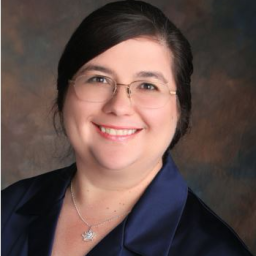
Sarah Sue Uthoff

http://trundlebedtales.wordpress.com

Posted in Uncategorized Tagged with: , , , , ,

Being Thankful

When Laura shares her feelings of thankfulness with her Missouri Ruralist readers, she makes note of all the things we sometimes don’t take the time to be thankful for, the everyday things to which we never give a thought. Inasmuch as we often regard her family life, as portrayed in her books, as stoic, we also must recognize the sheer gratitude that comes from recognizing that life, itself, is a gift.

She notes that a friend wrote to her, trying to find something to be grateful for in a tough year. “We are in our usual health,” her friend wrote. And Laura, countering that thought, points out that good health itself should be welcomed with gratitude.

I think about her words often during this week of Thanksgiving. Every year, I use this time to reflect about the year past, to take stock of what I’m grateful for, and to show those I love how grateful I am for their presences in my life. In years past, before my paternal grandmother died, the entire Mattson clan gathered at this one time of the year. My father, uncles, cousins and others every year congregate at our family hunting cabin for deer hunting season this week in Douglas County, Wis., and while she lived, they all showed up on Thanksgiving morning, ready to help with the bounty coming from Grandma Elsie’s kitchen.

She passed away in 2001, and the family circle, in the natural way of such things, shrunk to the individual households of her sons, who in turn have large families. (At the time of her passing, we counted 67 descendants.) Still, there’s a reminiscence at this time, as the hunters return with their deer, and traditional foods come out of our kitchens. Grandma’s donuts, lefse, chocolate layer cake with date filling, and spinach dip often turn up. They’re somehow not quite the same, but we’re grateful to have a flavorful reminder of her on our Thanksgiving tables.

This year, my family will join my husband and I here, and they’ll stay for a few days. It will be a bustling horde of folks, eager to help in the kitchen, playing games in the living room, crafting in the basement. Nearly every age is represented in this crew, and love abounds where we gather for food, fun, and family.

I’m grateful.

This year, I’m simply thankful for my family and their presence in my life. I’m thankful that they all can come and join us here, and I’m grateful to have the means for hosting them. It’s been a rough year for many.

But as Laura points out again and again, we don’ t need much when we have family.

What are you thankful for?

Posted in Uncategorized Tagged with:

LauraPalooza Details

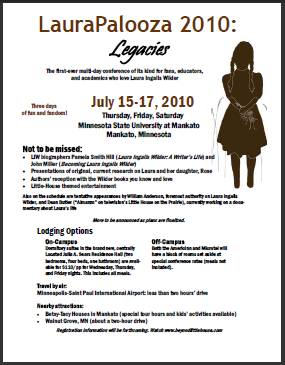
You asked for it. Here they are–the details on LauraPalooza 2010: Legacies. Click on the image below to a PDF with all the pertinent info. Questions? Write beyondlittlehouse at gmail dot com.

Details for LauraPalooza 2010: Legacies

Posted in Uncategorized Tagged with:

A Quilt With No Name Dove In The Window


Dove In The Window

Posted in Uncategorized

A Quilt With No Name Bears Paw


Bears Paw

Posted in Uncategorized

A Quilt With No Name

Summer has faded and the cool breezes are here. It’s the time of year when the drone of the air conditioner is replaced with the hum of the heater and I pull our heavy quilts out of their storage crates. One of my favorite quilts from my childhood, so thin with years of use, now graces my daughter’s bed. It was created by my great-grandmother and mother. I can still picture the unfinished quilt laid out on my great-grandmother’s table, with both her and my mother hunched over pinning down the fabric pieces to be appliquéd on.

Quilts were mentioned by Laura Ingalls Wilder in her books numerous times. When mentioned, quilts were mainly used for warmth. They were also laid out to sit upon and a quilt was hung as a temporary door over the door hole of the little cabin in Kansas. Three quilt patterns were mentioned in the books by their names – the Nine-Patch quilt, the Bear’s Track quilt, and the Dove-in-the-Window.

Quilts get their names from the quilting stitch, or running stitch, that holds the layers of the quilt together. A decorative top is sewn to a backing with batting sandwiched between the two layers, making the quilt. Quilts with no quilting stitch were tied and were also referred to as comforts or comforters. Instead of using a running stitch to quilt layers of the comfort together, pieces of thread or string were used to tie the layers together. Despite the differences between these techniques, quilt was a label that stuck through the years and is now commonly used to describe both types.

In the little house on Plum Creek Laura and Mary slept under a patchwork comforter. The comforter, despite not being quilted, used the same patchwork, or piecing techniques that became popular in the 1860s. New patchwork or piecework pattern designs were continually printed in magazines of the period and by 1889 the Ladies Art Company, a mail-order quilt pattern company, had several designs available. Unlike today, very few patterns had names. Most patterns introduced were labeled with numbers for identification. It was not until the 1930s that names were given to new and most existing patterns in magazines like Home Art, Country Gentleman, Kansas City Star, and Oklahoma Farmer.

In On the Banks of Plum Creek Laura “started a bear’s-track quilt. It was harder than a nine-patch, because there were bias seams” and that made it difficult to keep the seams smooth. In These Happy Golden Years Laura is packing her trunk to leave home and packed away “her Dove-in-the-Window quilt that she had pieced as a little girl.”

Was Laura’s Bear’s-Track quilt and Dove-in-the-Window quilt the same quilt? It is possible. There was a Bear’s Paw pattern that had similar construction to an early Dove-in-the-Window pattern. The pieces required for constructing the block are the same with only a slight difference in the layout of the colored pieces of cloth. It can be assumed that the quilt Laura made used this design but that leaves the arrangement of the pieces in question. Was the design a Bear’s Paw or a Dove-in-the-Window?

We may never know. It is likely this quilt was consumed during the fire that raged through their De Smet home. By the time either book was published, quilt blocks were generally named and it is probable the editors did not catch or question the different names of the quilts Laura mentioned. Originally Laura’s quilt block design would not have had a name but she most likely would have assigned the quilt a name based on the way she remembered it. Interestingly, at times, quilt blocks were given different names depending on the source and through the years quilt blocks have been renamed, occasionally reflecting current events. This makes quilt identification difficult because there is often no correct name for any design.

Without considering contemporary sources, three different blocks were called the Bear’s Paw block. There is also one called Bear’s Foot, which shares the same design as one of the Bear’s Paw patterns. There is no Bear’s Track block. The earliest record of this design was pattern #351 through the Ladies Art Company and that pattern made it in print after 1897. There was an earlier pattern – pattern #162, but the tracks are arranged in a clockwise position, like a pinwheel.

There are over a dozen patterns named Dove-in-the-Windows, all of them pieced together differently. The earliest and most recognizable pattern of Dove-in-the-Window was by the Ladies Art Company – pattern #215. Patterns #1-272 were in print by 1895.

Compare the Bear’s Paw and the Dove in the Window block side by side. Notice how the pieces required to construct the block are the same. It is the arrangement of the smaller triangles and color placement that make the blocks different. (Quilt block images used with permission from quiltstobestitched.com.)

If Laura remembered the design of the quilt correctly, was it a Bear’s Paw or a Dove-in-the-Window? Perhaps more importantly is the fact that the quilt was an essential household item on the frontier. Often quilts were pieced together and quilted with diligence and used for many years. They provided warmth and brightened homes. Each one is unique – pieced with the fabrics chosen, following a pattern or coming up with one’s own. Even a quilt with no name may provide a glimpse into the life and the personality of its creator.

Posted in Uncategorized Tagged with: , , ,

About Presenting at LauraPalooza …

I’ve been getting a note or call here and there from folks who’d like to present something at LP, but don’t have an academic paper to present.

When I plotted out the call for papers, I simply didn’t think about other categories of presentations that could be possible. If you have an idea for a presentation, make sure it adheres to the “Legacies” theme, and submit it as spelled out in the call for papers–as an emailed attachment. Be clear about your idea, who would be a part if it (especially if this is a panel proposal), and how it would tie into the theme. Make sure, too, that you specify why you should be the one doing the presentation you propose.

That’s all there is to it! We’d like to see what ideas you have!

Posted in Uncategorized Tagged with:

Twitter Rhymes

If you’ve been following Rose Wilder Lane and Half Pint Ingalls on Twitter, you’ve already seen this exchange — my favorite Twitter couplet ever, because it rhymes.

@HalfPintIngalls: Almanzo likes big bustles; he cannot lie.
@RoseWilderLane: As the young people say, Mama Bess, TMI.

Posted in Uncategorized Tagged with: ,

A Lesson from Ma

Ma Ingalls has apparently become a teacher in a new series out in blogland. I thought the first lesson a great one, and look forward to future installments.

What can you learn from Ma Ingalls?

Posted in Uncategorized Tagged with:

A Very Mary Celebration

This past summer, I took my niece to De Smet, South Dakota. As we soared across half the country high above the clouds in an airplane, I read By the Shores of Silver Lake to her and thought what a good thing it was we didn’t have to travel to De Smet the same way they did or we’d never get there!

Silver Lake is one of my favorite Little House books because of the hope the family holds, the richness of having all their needs met, the focus on the family’s life through the winter with no intruders except the Boasts who are such dear souls they simply belong. But I had forgotten, until I started reading it aloud to her for the very first time and hearing it through her ears, how dreadfully sad the beginning of that book is. Not four paragraphs into it and I was uttering the words that broke my niece’s heart: “…and Mary was blind.”

I had not been prepared for the sharp intake of breath, nor for the look of horror that flashed across her face. She quickly sought reassurance — some hope. “Did she get better? Could she see again later?” I quietly shook my head and gave her some time to process that before going on.

I didn’t expect it to be such a shock. Honestly, I think that I’ve just known Mary as being blind for so long that I forgot she didn’t already know it. I never remember it being such a traumatic experience for me, but then, Laura was always my favorite character. I never cared for Mary the way I did for Laura, and therefore, her personal tragedy didn’t affect me so greatly. My niece is different. Perhaps it’s the blonde hair, but Mary has always been her favorite. And now her favorite is blind. I guess it would be shocking.

She dealt with this dreadful blow by becoming obsessed with all things blind. This might be in her favor, as eye trouble runs in the family, and the adorable frames now perched upon her little nose are a hint that she’s inherited them.

It started when she and Sandra’s little brown-haired “Laura” befriended each other at the Ingalls Homestead, and they went for walks together across the very ground on which Laura and Mary used to take their evening walks. My niece played like she was blind, closing her eyes and sticking her hands out in front of her, while allowing Sandra’s daughter to lead her around. Oh, but they were funny!

But it didn’t end there. In De Smet, there is a Braille activity in the museum’s hands-on learning center and she set herself quickly to practicing writing numerous words and phrases in Braille. In Mansfield this fall, the museum had an actual Braille writer there for the kids to use, and again she was fascinated. (Mary actually used New York Point so I guess I’m going to have to introduce her to that next!)

And then there was the time she asked me why the Ingalls family didn’t train Jack to be Mary’s Seeing Eye dog.

(I neglected to remind her that (as the books tell it) Jack died right after Mary went blind anyway. Why bring up yet another traumatic moment? Although that traumatic moment was mine; after experiencing her shock at Mary’s blindness, I sobbed my way through Jack’s death thinking how very awful this was going to be for her, my little animal lover, and she was left entirely unfazed. Go figure.)

So just imagine my excitement when someone from the Museum for the American Printing House for the Blind contacted us a month ago asking for information on Mary Ingalls for an exhibit they were adding. Imagine my further excitement upon learning that said museum is located in Louisville, Kentucky. Why, that’s just the next state over! A “Little House” related activity close enough that we could actually drive there and back in the same day!? Such a thing is unheard of!

Just browsing through the museum’s site, I was already hooked even without the Mary exhibit. It looked like something my niece would just go crazy over. Add in Mary and the place was designed just for her! But that wasn’t all.

You see, a birthday party is in the works! A birthday party for Mary! Oh, my niece is excited! And so am I. The museum hopes to launch the new Mary Ingalls exhibit as part of this weekend and much “Little House” fun is anticipated. Mark your calendars for Saturday, January 9, 2010, from 10 am to noon. The event is free, but registration is recommended. Call  (502) 899-2365 to sign up.  And we’ll see you there!

Posted in Uncategorized Tagged with: , , ,