The First Four Years; Chapter 4: Section 13

Guest post by Suzanne Falck-Yi

Last week, a hailstorm shredded my garden.  I was standing at a window near my office at the local college, thinking of Laura and Manly in their first four years, watching marbles of ice pour out of the sky, thinking of my open windows at home and how my flowers just that morning had been so gloriously ripe with pinks and purples and greens.

When I could finally make my way home to shovel out the drifts of ice from my August garden, I found tomatoes bare of leaves and fruit, rhubarb leaves torn to mere holes, nasturtiums that had finally–finally!–started to bloom that day now turned into nothing but bare stalks.  I had looked over the yards of the other houses around town, and few seemed to have suffered as much damage as mine did–perhaps because of the random nature of wind and hail, perhaps because of the angle of roof and garden.

And that led me to think about Laura and Manly.  For me, the ruin of vegetables and flowers means I’ll go to the local farmer’s market more often for awhile.  For the Wilders and other homesteaders, the hail, the hot wind, the rain that came too much or not enough, the tornado that hit one farm and leapt across another could each mean, in this random world of chance, near-bankruptcy, potential foreclosure of a homestead, the devastating loss of a whole year’s labor.

In the other Little House books, we see a relentlessly persistent belief in the American Dream:  hard work, dedication, and perhaps a bit of luck can build a little house, feed a family, eke out enough to live even through a Long Winter.  But here in the posthumously-published and therefore less-revised and edited First Four Years, we see the other side of the story of homesteading farm life:   there might be some good times when a young couple can slip out for a quick ride on the horses between checking on their sleeping little girl in the house, and there might be quiet moments when a young woman can enjoy the freedom of the open prairie sky when she sneaks away from her farmwife’s duties, but for the most part, farming during the Wilders’ time meant unceasing, backbreaking, and at times overwhelming labor.  Joy, in this novel, comes only in brief moments of freedom from the confines of the house and farm and their unceasing workload.

And despite the unending labor, so much still depended not on human effort, but on chance and the weather.  At the beginning of this section of the novel, we see that…

As spring turned the corner into summer, the rains stopped and the grains began to suffer for lack of moisture. … For a week, the hot winds blew, and when they stopped, the young wheat and oats were dried, brown, and dead.

The trees on the ten acres were nearly all killed too. Manly decided there was no hope of replanting to have the trees growing to fulfill the law for the claims.

It was time to prove up and he could not.

Gone is the fiercely independent spirit of the other books, and instead we see Manly seeking loan after loan that he ultimately will not have the money to pay back and will not have the courage to discuss with his young wife before he borrows.  We see Manly failing to prove up on his claims because the trees have died and so he must pay the government $1.25 an acre to stave off others who might stake a claim on the Wilders’ land. We see Manly unable to keep his young family afloat.  And then a tornado touches down a quarter-mile from where Laura huddles in her cellar with baby Rose while Manly rushes home from town to see if they’ve survived the latest natural disaster.  They did, but clearly another round of devastation could come again at any time.

Throughout the Little House books, we’ve seen time and again how Laura evades writing in detail about the weakest, most vulnerable moments in her life.  Her initial approach to telling of Mary’s blindness was to gloss over Mary’s debilitating illness at the beginning of the first manuscript version of By the Shores of Silver Lake.  Pa’s indebtedness and the death of the Ingallses’ baby boy, though recounted in the not-yet-published manuscript Pioneer Girl, were omitted entirely from the Little House series.  The final months of near-starvation in The Long Winter were skimmed over as Laura sank into a weakened state of apathy.  Similarly, in The First Four Years, again we see the author’s tendency to protect herself emotionally; she avoids writing in detail about her unnamed baby son’s death, only briefly mentioning it before the narrative rushes back to the list of chores that must be done:

Laura was doing her own work again one day three weeks later when the baby was taken with spasms, and he died so quickly that the doctor was too late.

To Laura, the days that followed were mercifully blurred. Her feelings were numbed and she only wanted to rest–to rest and not to think.

But the work must go on.  Haying had begun and Manly, [her cousin] Peter, and the herd boy must be fed.  Rose must be cared for and all the numberless little chores attended to.

The urgent need to find enough hay for the growing number of animals on their farm receives more description than does their son’s short life.  And yet, Laura had to keep on going, cooking and watching Rose and finding a means of living through her grief by throwing herself into the work of a farmer’s wife. The workload so overwhelms this young farmwife that it is the work, more than the mourning, which controls her thinking.

On the other hand, perhaps it was the work that helped her to set a limit on the boundless sense of loss she must have felt, spending her days alone with a toddler in a little house on a homestead that would not in the end prove up.  “An endless significance lies in work,” wrote the nineteenth-century thinker Thomas Carlyle, and perhaps it is through work that Laura and Manly found significance for this bleakest part of their lives.

Posted in Uncategorized Tagged with: ,

Overcoming Our Difficulties

“A difficulty raiseth the spirit of a great man. He hath a mind to wrestle with it and give it a fall. A man’s mind must be very low if the difficulty doth not make part of his pleasure.” By the test of these words of Lord Halifax, there are a number of great persons in the world today.

After all, what is a difficulty but a direct challenge? “Here I am in your way,” it says, “you cannot get around me nor overcome me! I have blocked your path!” Anyone of spirit will accept the challenge and find some way to get around or over, or thru that obstacle. Yes! And find pleasure in the difficulty for the sheer joy of surmounting it as well as because there has been an opportunity once more to prove one’s strength and cunning and by the very use of these qualities cause an increase of them.

The overcoming of one difficulty makes easier the conquering of the next until finally we are almost invincible. Success actually becomes a habit thru the determined overcoming of obstacles as we meet them one by one.

If we are not being successful, if we are more or less on the road toward failure, a change in our fortunes can be brought about by making a start, however small, in the right direction and then following it up. We can form the habit of success by beginning with some project and putting it thru to a successful conclusion however long and hard we must fight to do so; by “wrestling with” one difficulty and “giving it a fall.” The next time it will be easier.

For some reason, of course according to some universal law, we gather momentum as we proceed in whatever way we go, and just as by overcoming a small difficulty we are more able to conquer the next, tho greater, so if we allow ourselves to fail it is easier to fail the next time and failure becomes a habit until we are unable to look a difficulty fairly in the face, but turn and run from it.

There is not elation equal to the rise of the spirit to meet and overcome a difficulty, not with a foolish over-confidence but keeping things in their proper relations by praying, now and then the prayer of a good fighter whom I used to know. “Lord make me sufficient to mine own occasion.”

“Overcoming Our Difficulties”  by Laura Ingalls Wilder, published in The Missouri Ruralist, August 20, 1918

Posted in Uncategorized Tagged with: ,

The First Four Years; Chapter 4: Section 12

Guest post by Barbara Mayes Boustead

The 1880s were a cruel decade in the Dakota Territory and elsewhere on the Plains.  Winters were brutally cold and snowy, with vicious blizzards (extra credit if you can remember which winter was the mild exception!).   Worse for the new settlers, though, was the period of particularly dry weather that started in the late 1880s and continued into the 1890s.  Homesteaders unknowingly had settled the Plains during a relatively wet period in the late 1870s to early 1880s.  The dry summers were too much to take for many would-be farmers, who abandoned the Dakotas and nearby areas during the drought in the 1890s… right around the time that Laura and Almanzo also abandoned ship.  But we’re getting ahead of ourselves.

The summer of 1889 is the 17th driest on record in nearby Huron, SD, with just 5.21 inches of rain from June 1 through August 31.  If this was supposed to be the year in which Laura and Almanzo decided if farming was a “success”, they were facing an uphill battle.

We start this section in April of 1889.  Laura’s recollection of an early, warm spring is accurate, as the high temperatures in March were well above normal.  The last really cold days were on March 13-14, though low temperatures still dipped below freezing consistently through March, with a couple of sporadic freezes through early May, ending the freeze season a little early compared to average.  March was a dry month, as well, with just 0.19 inches of rain (compared to a normal of about an inch and a half).  April and May both had near-normal rainfall, but the rains came mostly on a couple of wet days.  From April 19 through May 10, measurable rain fell on just one day, and that was just a tenth of an inch.

Once again, Laura was very precise about the date of a weather event in this book : April 2, 1889.  But was she accurate?

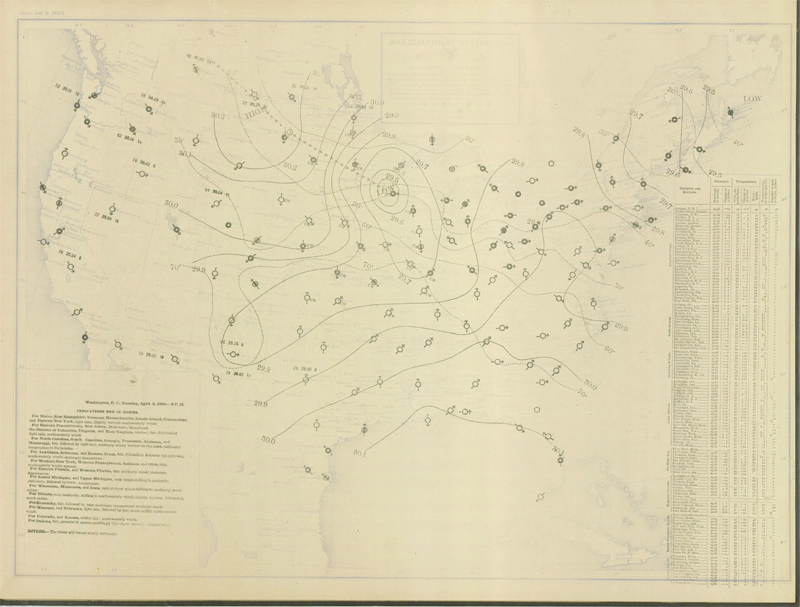
The high temperature on April 2 was 70 degrees, which is quite balmy.  On April 3, the high rose to just 48 degrees.   A cold front must have passed through, which would have brought a switch to northwest winds, but let’s see if we can document that further.  Wind records in this period aren’t great, but I do have enough data in the historical records to know that the winds were very strong on April 2, and that they were indeed out of the northwest by afternoon.  We also can look at historical weather maps (like the one below) and see that a strong low pressure system moved from northwest Dakota Territory to central Minnesota through the day, with a cold front sweeping through the Dakota Territory.


Weather map on April 2, 1889, at 8 PM local time.  Low pressure is centered in central Minnesota, and the closely-packed isobars (pressure lines) over the Dakotas would bring strong winds.  Arrows on the station plots behind the low show northwesterly winds.

I think she finally got one right!

On the heels of a dry March, the dust could have been stirred by a brisk northwest wind pretty easily.  Dust storms evoke iconic images like those of Dust Bowl dusters, with opaque clouds of angry black dust lurking behind cars, houses, and vulnerable families.  These storms aren’t just a product of the Dust Bowl drought, though, and they can happen in dry years on the Plains, even now.  In the midst of a dust storm, visibility can drop to near zero, with the added pain of sandpapery dust flying into the eyes and ears and mouth and nose.  The effect of a “black blizzard” is just as disorienting as a good old snow blizzard.

(Image link: http://www.photolib.noaa.gov/htmls/theb1365.htm)
Dust storm approaches Stratford, TX, on April 18, 1935.

Vegetation in South Dakota is not usually greening much by early April, even with some warm days.  The ground cover is the browned, dried-out remnants of last year’s plants, and the dry March would have only helped it become even drier.  It’s no surprise that a prairie fire would be ignited, and with such strong winds, would be carried quite a distance.  Prairie grass burns rapidly, and the only saving grace is that it doesn’t burn as hot as, say, a forest fire.  But fire is dangerous regardless, especially under windy conditions that make it hard to escape.  With the dust storm limiting visibility and with winds causing rapid advance of the fire, it’s likely that the flames would have arrived with little warning to anyone in its path.

Of course, Manly and Cousin Peter save the sheep and douse the stray flames that threatened one of their haystacks, dodging the worst of the prairie fire that burned an extensive path to “the river” (the Vermillion or Big Sioux, perhaps?).  They reseed the fields and shear the sheep, and spring moves into summer.

Rose, now a two-and-a-half year old toddler, keeps Laura busy by, well, being a toddler.  She falls into a tub of water, rolls in the dirt after a bath, and becomes a hurdle for the playing colts.  Laura, like any (pregnant) young mother, struggles with balancing housework and watching her daughter.  I don’t have a child myself, but as a child of the outdoors myself, I really appreciate that she wants to continue to allow Rose to play outside in the beautiful weather, rather than keep her “safe” in the house.  Laura becomes determined to manage, a very Laura-like attitude that we saw develop when she was teaching her first school.

But Laura is worried about money.  Her analytical brain goes to work on the sums, reminiscent of the mental arithmetic tests during the school exposition, and she struggles between pride and practicality as she debates whether to purchase coupon books from the merchants.  She shrugs off the worry to close the section, shifting responsibility to Almanzo.  The Laura in this section has always struck me as very similar to the characteristics of Scarlett in Gone with the Wind – an analytical brain at work, practicality and pride in conflict, and worrying about the consequences later.

Unfortunately, the calculations about what is needed to pay the bills serve as foreshadowing to a tough summer ahead.


Posted in Uncategorized Tagged with: ,

Beyond Little House Talks to Bill Anderson about New Walnut Grove Book | Beyond Little House

On August 9, the Laura Ingalls Wilder Museum at Walnut Grove released a new book by esteemed Wilder biographer and LauraPalooza featured speaker William Anderson, Laura Ingalls Wilder’s Walnut Grove. We caught up with Anderson to find out more.

Beyond Little House: There’s already a book about Walnut Grove. Why the need for a new one?

William Anderson: It was 1987 when Shirley Knakmuhs suggested that Walnut Grove have a special publication about the museum’s history and that of the Ingalls family for their site. I was in a six-week seminar at the time, “Classics on the American West,” at the University of California-Davis. The seminar met only for two hours each day, so when I was not exploring northern California with my classmates, I worked on this publication for Walnut Grove. We were studying Willa Cather’s My Antonia, so I was certainly in the mode of sod houses, blizzards, Norwegians, little towns “buried in wheat and corn,” and frontier women losing their minds on the prairie.

So much more knowledge has accumulated since I wrote that first title! [Collections Manager] Nicole Elzenga at the museum has done an amazing job gathering just about everyting knowable about the people and places of “Plum Creek.” She shared material with me, and she and [Director] Amy Ankrum also suggested certain topics they wished me to cover. The museum has grown by leaps and bounds—a whole complex surrounding the original Depot Museum. And Stan and Hazelle Gordon have amplified the Plum Creek site and farm, ever so gently. It was time to revamp and update. I could not have done it without so much input from the museum staff and book designer Cerise Dixon.

Beyond Little House: How different is this new book from the original?

William Anderson: This book is a 96-page production with mostly color pages. It fits well with the Little House Guidebook. I tried to scrape the bottom of the barrel for some new images and data. Several holders of private photos and documents agreed to share them, anonymously. This is also the first book I’ve done that summarizes the television version of “Little House on the Prairie.”

Some other voices contributed to this book. Dean Butler (Almanzo Wilder) and Charlotte Stewart (Eva Beadle) wrote some wonderful anecdotal accounts of their lives on the TV show. I wanted to focus on the international appeal, so Yumiko Taniguchi and Eric Caron handled that. My family’s almost-lifelong friend, Jane Myers, tells of her family’s trek to Plum Creek over 50 years ago. They were about the first folks to take the trek to the sites.

This is also the first time that the illustrators were fully recognized.

Beyond Little House: How and when did you research this book?

William Anderson: The research was essentially resting in my files, other than all the “new” data contributed by the Walnut Grove Museum. I planned the book in my head for almost a year before writing it earlier in 2013. I have been to Walnut Grove so many times that it was part of my fabric, so I think the research was cumulative.

Beyond Little House: What interesting or cool thing did you unexpectedly uncover this time around?

William Anderson: One of my favorite sections was written by Stan Gordon, who grew up on the farm [that contains the Ingalls’ property]. He more or less settles the fact that the “wonderful house” can never be found, so let’s give up the angst concerning that unsolved mystery. Look around on all that great prairie and imagine it. That is what Laura Ingalls Wilder led us to do in her book.

I also realized that the development of Walnut Grove as a tourist place was like a long simmering pot. We owe much thanks to the Lantz family, who kept writing about this “children’s book” in their newspaper. Who cared about children’s books in a community where farming was king? And the quiet heroism of Della and Harold Gordon—they bought the former Ingalls farm for agriculture. They could have posted the place with “no trespassing signs” and ignored the people who wanted to stroll around their land. The Gordons typified a midwestern spirit of generosity and humble serving. They owed no one anything. I think that is a message in the Little House books: we are not owed anything. Our actions and kindness are expected parts of our lives. We make history; government or the public sector doesn’t.

Visit the gift store of the Laura Ingalls Wilder Museum in Walnut Grove to purchase the book or call 1-800-528-7280 to order.

Posted in Writings About Laura Tagged with:

Laura Legacy Award Ceremony 2012


During LauraPalooza 2012, we had the second Laura Ingalls Wilder Legacy Award presentation ceremony. This award is presented to someone living who has strongly contributed to improving Laura Ingalls Wilder fandom. The award was first presented to William T. Anderson in 2010. The 2012 recipients were Barbara Walker and Shirley Knakmuhs. There was a problem with the filming of the actual event, but an audio recording was made. The videos below are a mix of the video that was taken, recreations of my part of the hosting duties, and photos from the event paired with the audio recordings.

Part 1

Part 2

Part 3

Part 4


Sarah S. Uthoff blogs at TrundleBed Tales; look for her on Twitter and YouTube and Blog Talk Radio
Laura Ingalls Wilder Legacy and Research Association, Acting President

Posted in Uncategorized Tagged with: , , , , , , , , , ,

Happy Anniversary

Laura and Almanzo sat waiting. In the center of the sitting room a marble-topped table stood on a crocheted rag rug. On the wall was a large colored picture of a woman clinging to a white cross planted on a rock. with lightning streaking the sky above her and huge waves dashing high around her.

The door of the other bedroom opened and Ida slipped in and sat down in a chair near the door. She gave Laura a frightened smile and then twisted her handkerchief in her lap and looked at it.

The kitchen door opened and a tall, thin  young man quietly slipped in a chair. Laura supposed he was Elmer but she did not see him, for Reverend Brown came from the bedroom, thrusting his arms into his coat sleeves. He settled the coat collar to his neck and asked Laura and Almanzo to rise and stand before him.

So they were married.

From These Happy Golden Years; Chapter 33: Little Gray Home in the West

Posted in Uncategorized Tagged with: , ,

Malone Unveils Schoolhouse

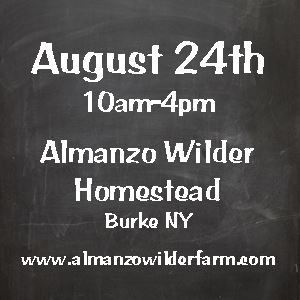
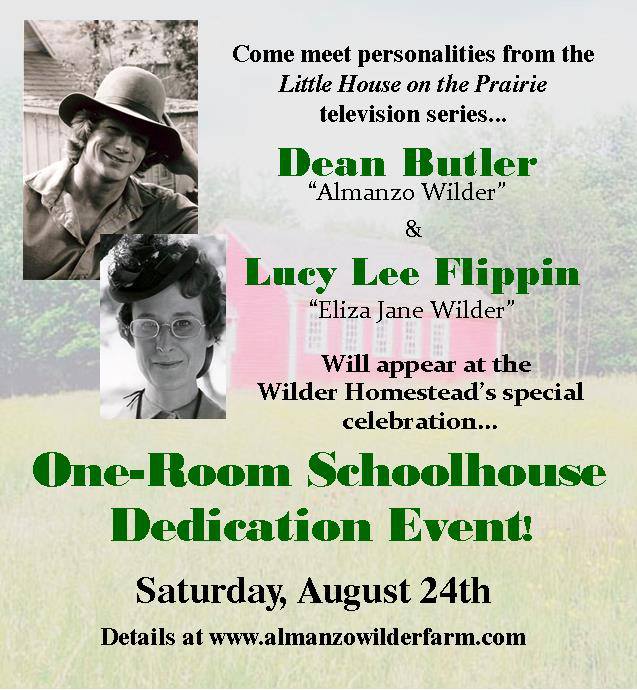
The Almanzo Wilder Farm has finished its replica one-room school project and is unveiling it in a big event with guest speakers this Saturday. Sadly I won’t be going, but board member Connie Neumann is so we look forward to her report. They didn’t share one poster about the event, but a series of images with all you need to know if you can get to New York state, it’s the place to be this weekend. – SSU

Posted in Uncategorized Tagged with: , , , , , , , , , ,

The First Four Years; Chapter 4: Section 11

Guest post by Melanie Fishbane

We leave the third year behind, a year where Manly suffered the stroke that would leave him partially paralyzed for the rest of his life. The stroke that probably meant that he could no longer do the work that he wished to do, to be the farmer he had dreamed he could be.  Yet, when we begin this “Year of Grace,” Laura asks Manly if with all that they had suffered if their farming was a success, and he says, “Well, I don’t know, it is not so bad.”  Not so bad.

Well, Wilder does say that Manly’s hands were not so “stiff and clumsy” so perhaps he’ll be able to hitch up the horse himself. Manly isn’t going to let a stroke or poverty get him down! Instead, he focuses on all that he and Laura do have. All they need is one good crop and it will all be okay, he tells her. One good crop. The dreamer emerges once again and I think that was one of the things that Laura must have loved about him for she was one, too, and so she agrees.

Still, the title of this section feels like a bit of lie. Things might seem okay, but there’s a foreboding within these ten pages because I know what’s coming.  We see it in Laura’s worrying about the debt. Being Ma’s and Pa’s daughter she doesn’t like the idea of owing anyone money. She worries that the binder hasn’t been paid yet and it was hard to make the interest payments. And they buy two of the heavy oxen, King and Duke, to give their horses a break and do the light work. And while we see the reasoning behind it, there is still that lingering whisper, “Why are you spending more money?”

I think, as a kid reading The First Four Years I would skim it looking for the familiar Laura and Almanzo, not always satisfied that I had found them. The tension in this section happens so subtly that I wonder had Wilder gone back to the manuscript how she much would have strengthened it.

We witness many close shaves and scares, like Laura losing Rose while hitching up the horses, only to find her behind Fly’s tale. Even Garth Williams understood the importance of this scene for he gave it a full-page illustration. Laura is frightened and rightfully so for her daughter is standing behind a horse and (as a farmer once yelled at me when visiting a farm as a kid) that is a dangerous place to stand.

Thanks to Manly’s carpentry skills, the Wilders and cousin Peter have a mild and pleasant winter but one night as Manly and Peter are doing the evening chores they hear the wolves howling.  Wilder flips quickly in points of view here, showing Manly’s concern that the wolves will come after the sheep, but Peter is confident that with Laura there nothing will happen.

Back at home, supper is almost ready and Laura is getting worried. Rose has eaten already and sleeping with their big black dog, Nero, who growls when the wolves howl.

Laura leaves Rose sleeping and takes Nero and a lantern to scope things out. Grabbing a five-tinned stable fork, she and the dog slink around the area ready to strike.  But once again all is well for it seems that the wolves have gone west.

I love the confidence that Laura exudes when Manly asks her what she would have done had she come face to face with the wolves: “Why driven them away, of course. That’s what I took the pitchfork for (106).”

Soon after Laura has the “familiar” sickness and the house feels close and hot and she is quite depressed. (I don’t think that as a kid I had picked up that she was pregnant again and was surprised when she later gives birth.)  Once again Laura’s mental health is saved by the convenient entry of her bachelor neighbor, Mr. Sheldon who pops in unexpectedly to give her a paper-backed set of Waverly novels.*

In a bit of bibliotherapy, Laura loses herself story, healing her depression and anxiety with the heroic tales of knights and ladies, bringing some of the old magic and music back to the wintry prairie.

* Sidebar: I looked these up and the Waverley books are a collection of 28 novels by Sir Walter Scott in the early 19th century focusing on the Highlands. The collection seems to be spelled wrong or differently in the novel, because when I looked these up online it is “Waverley.” Scott didn’t publically acknowledge authorship until 1827, but for Wilder she would have known who wrote them.


Posted in Uncategorized Tagged with: ,

Put Yourself in His Place | Beyond Little House

Once upon a time, a crowd of men were working in the woods where they had to do their own cooking. They took turns at being cook and they made a rule that when any one of them found fault with the food provided, that man must take the cook’s place, until he in turn was released from the distasteful job by someone’s finding fault with his cooking.

This worked very well, with frequent changes in the occupancy of the cook shanty, until the men had learned better than to criticize the food. No one wanted to take the cook’s place so they became very careful about what they said and the poor unfortunate who was cooking for the hungry crew saw no chance of escape. He was careless as to how his work was done but no one found fault; he burned the biscuit, then he made the coffee too weak but still not one objected.

At last he cooked a mess of beans and made them as salt as brine. One of the men at supper that night took a huge mouthful of the beans and as he nearly strangled, he exclaimed, “These beans are sure salty!” Then as the eye of the cook, alight with hope, glanced in his direction, he added, “But my, how good they are!”

It is so much easier to find fault with what others do than to do the thing right one’s self. Besides, how much pleasanter to let some one else do it. Of course a mere woman is not expected to understand politics in Missouri, but there is no objection to her understanding  human nature and it is certainly amusing to watch the effects of the working of human nature on men’s political opinions. I know of some men who were all for war during President Wilson’s first term. “The United States soldiers ought to go down there and take Mexico! A couple of months would do it! The United States should fight if our shipping is interfered with. It would be easily settled.” There was much more to the same effect, but now that the fight is on and there is a chance for them to show what they can do, their fighting spirit seems to have evaporated. it was easy to find fault, but rather than do the work themselves, almost anything is good enough. It is the quiet ones who hoped we might be able to keep out of war who are volunteering.

One after another our young men are enlisting. Eight in a body volunteered a few days ago. The war, the terrible, has been something far off, but now it is coming closer home and soon we shall have a more understanding sympathy with those who have been experiencing its horrors for so long. There is nothing quite like experience to give one understanding and nothing more sure than that if we could be in the other fellow’s place for a while we would be less free with our criticisms.

In the days of long ago when armored knights went journeying on prancing steeds, two knights, coming from opposite directions, saw between them a shield standing upright on the ground. As the story goes, these fighting men disagreed about the color of the shield and each was so positive, the one that it was black, and the other that it was white, that from disputing about it they came to blows and charged each other right valiantly. The fury with which they rode their steeds carried each one past the shield to where the other had stood before, and as they turned to face each other again, each saw the side of the shield which the other had first seen and the man who had said the shield was white found the side he was now looking at to be black, while the one who had declared the shield was black found  himself facing the white side, so each got the other’s point of view and felt very foolish that they had fought over so simple a thing. It makes a difference when you’re in the other fellow’s place.

“Put Yourself in His Place”  by Laura Ingalls Wilder, published in The Missouri Ruralist, August 5, 1917

Posted in Quotations from Laura Tagged with:

New William Anderson Book Released | Beyond Little House

Laura Ingalls Wilder scholar William T. Anderson and Laura Ingalls Wilder Legacy Award Winner sent us this announcement. I, for one, can’t wait to see what he’s written. It’s available for purchase right NOW at the gift shop at Walnut Grove. Purchase it online or call them at: 1-800-528-7280. – SSU

A new book was released August 7, LAURA INGALLS WILDER’S WALNUT GROVE, by William Anderson. This is a 96 page, full color book, with new information, some previously unseen historic photos, and data.

The book tells about the writing of ON THE BANKS OF PLUM CREEK, its illustrators, the life of the Ingalls family on the creek and in town, the development of the museum and creek site. Dean Butler and Charlotte Stewart contribute their memories of “Little House” life on TV and the NBC Little House on the Prairie television series.

This new title has been called “Everything you want to know about Walnut Grove”. To get first edition copies, contact the Wilder Museum in Walnut Grove.

The book costs $13.95, shipping depends on destination. Be aware that when you order it online it defaults to priority mail.

Posted in Announcements Tagged with: , ,