The Great Debate | Beyond Little House

It seems we have a bit of a debate on our hands.

This article out of the Boston Globe appeared just a few days ago.

And then this article on bloomberg.com, a rebuttal of sorts, just came through my Google alerts.

I won’t be wordy here so that you can read them both. But… what say YOU?

August 15, 2013 – Edited to add: Yet another article. This time in the Washington Post online.

Posted in Laura's Legacy, Little House in the News, LIW-Related Items

As They Say, “Totes Adorbs” | Beyond Little House

So I’m not “friends” with Kevin “Almanzo from the musical” Massey on Facebook, ’cause that would be weird, but I did visit his page recently on a whim to see if perhaps he’d posted some wedding pictures for public consumption, ’cause dang do I adore that sweet theater couple. And yes, there is one, so yay!

But even better was my discovery that his header image is of him and his now-wife, Kara Lindsay, on the cutter, back when they were singing “Faster, Faster!” onstage at the Guthrie Theater.

Go see.


Posted in Musical–Little House on the Prairie, Uncategorized

The First Four Years; Chapter 3: Section 10 | Beyond Little House

Guest post by Sue Poremba

Around the same time I began reading the Little House books, I began reading biographies of famous Americans – mostly presidents and first ladies. Presidential history now fascinates me as much as the life of Laura Ingalls Wilder, so it seems right that this particular section fell into my lap.

For, you see, Cousin Peter comes to Laura and Manly to tell them Mr. Whitehead wanted to sell his 100 purebred Shropshire sheep.

“A presidential election was coming in the fall, and it looked as though the Democrats were due to win. If they did, Mr. Whitehead, being a good Republican, was sure the country would be ruined,” Laura wrote.

So my brain began to spin. This was the “third year.” Laura and Manly married in 1885, so this would be the election of 1888. Something seemed off kilter here, I thought. So I began to do a little digging.

The president when Laura and Manly married was Grover Cleveland, a Democrat. The election of 1888 was between Grover Cleveland and Benjamin Harrison. When all the votes were tallied, Cleveland won the popular vote but Harrison won the Electoral College, and it was Harrison, the Republican, who was sworn in March 1889.

So, was Laura saying that Mr. Whitehead was worried that the Democrats were due to win re-election? Or did her memory fail her – after all, there was a long string of Republican presidents during her childhood and young adult years and most people are hard pressed to remember who was president at any given time. She also may have confused this election with the second election between Harrison, now incumbent, and Cleveland, where Cleveland does win and the country enters the Panic of 1893.

What does this have to do with the actual section of the book I’m supposed to be writing about? Well, perhaps nothing, but the fact that the Panic actually happened five years later allowed Laura and Manly and Peter to make a profit from the purchase of the sheep, whereas, if the country’s ruin happened as Laura had written it, it is likely that the sheep purchase would have been a bust.

Laura and Manly took a huge risk with the purchase of the sheep. To buy them, Manly sold the colt bought with the last of Laura’s teaching money. $100 was a fortune and could have helped to pay the increasing debt. They had already seen their share of crop failures. Even though things were looking good – if there was no hailstorm – there were no guarantees. Sure enough, when the time to harvest the wheat was nearing, a severe heatwave hovered over the Dakota prairie and cooked the wheat. It would feed the livestock, but nothing else.

At least the sheep would have something to eat in the winter.

There was something very telling about the personalities of Laura and Manly in this section. When Cousin Peter first presented the idea of the sheep, Laura began to calculate how much money the wool would bring in and how the sheep would pay for themselves in that first year, as well as using the public land next to the tree claim for them to graze. Yes, there were variables (Mr. Whitehead’s prediction of a nation in ruins), but even if the sheep didn’t pay for themselves in the first year, a profit would most likely come eventually. From her life with Manly, she saw how animals on the farm could be profitable.

Manly did some calculations, too. He began to calculate how much wheat he’d be harvesting and how much he’d be able to get for a bushel. He started to mentally pay off their debts. Certainly, he had to know that until the wheat was harvested and sold anything could happen (Manly could have used our pal Barb* to send him some weather predictions!).

Laura was a realist who wanted some guarantees with her risk. Manly was an eternal optimist who believed good things were always just around the corner. But sometimes it is all a matter of luck. When they bought the sheep in 1888, they were darn lucky that the Panic and the country’s ruin wouldn’t come for another five years.

*LIWLRA’s own resident meteorologist Barb Boustead.

Posted in The First Four Years Tagged with: ,

The Family Motto | Beyond Little House

It has become quite the customary thing for farms to be given a distinguishing name. It adds much to the interest of a farm home, especially as the name usually calls attention to some feature of the place that marks it as different from the farms surrounding it.

Naming the home place is an old, old custom, but the people who lived at such places used to have a family motto, also. Families as well as farms have distinguishing traits of character, and there is always some of these on which a family prides itself. Only the other day I heard a man say, “My father’s word was as good as his note and he brought us children up that way.”

Why not have a family motto expressing something for which we, as a family, stand?

Such a motto would be a help in keeping the family up to standard by giving the members a cause for pride in it and what it represents; it might even be a  help in raising the standard of family life and honor.

If the motto of a family were, “My word is my bond,” do you not think the children of that family would be proud to keep their word and feel disgraced if they failed to do so?

Suppose the motto were, “Ever ready,” would not the members of that family try to be on the alert for whatever came?

Perhaps it would be possible to cure a family weakness by choosing a motto representing its opposite as an ideal for the family to strive toward. We might keep our choice a family secret until we had proven ourselves and could face the world with it.

Tho, in these days, we would not put the motto upon our shield as did the knights of old, but we could use it in many ways. If carried only in our hearts, it would draw the family closer together.

Let’s have a family motto as well as a farm name!

From “As a Farm Woman Thinks (12)”  by Laura Ingalls Wilder, published in The Missouri Ruralist, August 15, 1922

Posted in Quotations from Laura Tagged with:

Read-along Update | Beyond Little House

We’re down to the last five sections in the The First Four Years read-along. If you want to get caught up, just click on the link in the sidebar there → on the right of the page. As a matter of fact, there’s a link for each read-along that we’ve done here at Beyond Little House. If you click on the book title it will take you to a page where you can link back to each chapter so you can catch up on the current read-along or just check out (or re-live) the past ones.

If you are one of the lucky last five participants of the read-along and you’ve finished your section already, please go ahead and send it in to beyondlittlehouse (at) gmail (dot) com. That way it can be posted right away when its turn comes up.

You’ve not yet participated in one of our read-alongs? Never fear! We’ll be doing another one after the first of the year. Join us. It’ll be fun!

Posted in The First Four Years Tagged with:

Will THIS Project Be the One? | Beyond Little House

So my Google alerts, um, alerted me to this story yesterday about yet another Laura Ingalls Wilder project in the works. This comes from Pineapple Express director David Gordon Green, who was quoted as saying he has read Little House in the Big Woods. (We will generously assume that was only the beginning of his research.)

Will it work? Impossible to know. I’m glad someone’s trying, though, even if he’s the eleventy millionth one to do so.

Which LIW projects outside of the books did you enjoy the most? Here’s my admittedly fully biased opinion, in no particular order:

Beyond the Prairie: The one The Wilder Life author and LauraPalooza guest Wendy McClure affectionately refers to as “the one with the crazy Dawson’s Creek girl“—and I concur with the description—had pretty much nothing going for it. Bad clothes, bad hair, bad everything. It creeped me out. And I still have trouble with that name “Loudermilk.”

Little House, the Musical. (Click just to hear the music!) I loved this. I loved it in Minneapolis, I loved it in New Jersey, and I loved it in Denver. Even with the mis-pronounciation of Manly’s name. Kara Lindsay brought a dimension to Laura I didn’t think I could discover; Kevin Massey became Almanzo in the flesh in a way I never thought possible. The two knelt down for a sweet little wedding at every performance—and then did it for real this past year. Swoon. (And let’s not forget Carly Rose Sonenclar, who played Carrie, made her own splash last year on The X Factor. Remember?)

Little House on the Prairie Disney miniseries. I waxed poetic about this Friendly production in the Homesteader already. Suffice it to say: it could have worked. It really could have worked. But it didn’t. (Although I don’t think Mary could ever be cast more perfectly.)

Rose books. I count these as Laura experiences outside the realm of the books. Tell me I’m not the only one who was excited to read about Laura debating. Resolved: the Rose books feel just a teensy bit like a Laura continuation.

What say you? Which LIW projects worked—or didn’t work—for you?

Posted in Cultural Impact, Little House in the News, Musical–Little House on the Prairie, Random Little House Sightings, The Homesteader Newsletter, Writings About Laura

Sharing the Love | Beyond Little House

I love this article for so many reasons.

I think you’ll agree. It’s heartwarming to read about a little boy who read and loved the Little House books and went on to share that love with his own children.

It also mentions LauraPalooza and our own LIWLRA president, Sarah Sue Uthoff and her Trundlebed Tales podcast. So that makes it that much better!

Posted in Laura's Legacy, LauraPalooza 2012, Little House in the News

Never Too Old | Beyond Little House

For many of us women who are not getting any younger and feeling that we have not accomplished all that we want, there is hope!

Check out this list of nine women who succeeded later in life on Huffington Post. You shouldn’t be surprised about who made the list! And at #2!

Posted in Laura's Legacy

Mansfield Wilder Days Announces Guest | Beyond Little House

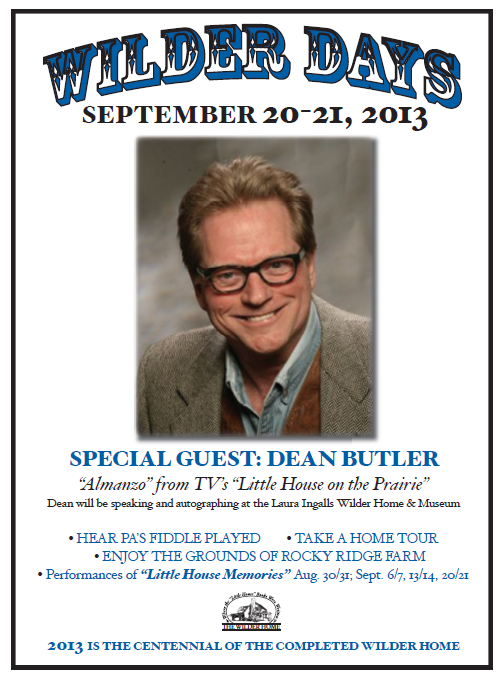
Mansfield Wilder Days have put out their flyer for the event. 2013 is the 100th anniversary of the final major addition (the living room and front porch part that makes the front of the house) was finished. They had rolled out a lot of new events last year, but were hampered by heavily rain. Hopefully the weather will be better this year.

Wilder Days Flyer

Posted in Homesites, Museums and Attractions Tagged with: , , , , ,

The Farm Wife

“We are going to be late getting the hay in from the west meadow. Can’t you come and rake it or us?” said The Man of the Place.

I could and did; also I drove the team on the hay fork to fill the big barn, for such is the life of a farmer’s wife during the busy season.

“The colt has sprained his ankle. Come pet him while I rub on some liniment, and while you are there I wish you’d look at the red heifer’s bag and see what you think best to do for that swelling on it.”

And so I halter broke the colt while The Man of the Place bathed the lame ankle and then we decided that the red heifer had been bee stung and bathed her udder with salt and water.

I hae finally got the weakly calf into good growing condition and turned it out in the pasture with the others, for I am by way of being an understudy for the veterinarian.

“What would you raise next year on the land we cleared of brush down by the creek? The hay on it is too think and it must be broken up?” This was the question for my consideration at the breakfast table, and my answer was, “Raise the same crop on that as you do on the remainder of the land on that side of the creek. One large field is better than two small ones and time is saved in working. Put it into the regular rotation with the rest.”

Not that The Man of the Place would do as I said unless he agreed with me, but getting my ideas helps him to form his own opinions and he knows that two heads are better at planning than one.

One of my neighbors is managing the farm this summer during the absence of her husband. She planted and cultivated, has attended to the harvesting and threshing and  haying. She, with the children, cares for the horses and cows, the pigs and poultry. She buys and sells and hires and fires. In short, she does all the work and business that her husband would do if he were here and keeps up her own work besides.

United States Commissioner of Education, Philander P. Claxton, says that on a farm it is the “Know-All and Do-Everydumthing” that makes for success. If this is true for farmers it is much more for their wives. A farmer’s wife is expected to, and usually does, know as much about the farm as her husband and in addition she must know her own business of housekeeping and homemaking.

A farmer to be successful must understand his machinery and be a sort of blacksmith. He must be a carpenter, a road builder, enough of a civil engineer to know how to handle the creeks and washouts on his farm. He must, of course, understand all about the care of the animals on the farm in sickness and in  health; he must know all about the raising of crops and handling of soils, the fighting of pests and overcoming of weather conditions and in addition must be a good business man so that he shall not lose all the fruits of his toil in the buying and selling end of the game.

Besides being a  helper in all these things with brains, and muscle if necessary, the farmer’s wife must know her own business, which includes the greatest variety of trades and occupations ever combined in one all-around person. Think of them! Cook, baker, seamstress, laundrywoman, nurse, chambermaid and nurse girl. She is a poultry keeper, an expert in dairy work, a specialist in canning, preserving and pickling, and besides all else she must be the mother of the family and a smiling hostess.

Dr. Claxton is advocating a change in rural schools so that they shall prepare farmers and farm women for their work, for as he says, “A man’s life is his work! And a woman’s life is her work!”

From “The Farm Wife (7)”  by Laura Ingalls Wilder, published in The Missouri Ruralist, August 5, 1919

Posted in Uncategorized Tagged with: ,