The Long Winter, Chapter 27: For Daily Bread

Guest post by Karen Witham

In which our hero and his brave sidekick set out in search of lifesaving wheat…

The chapter opens: “In the third night of that storm a stillness woke Almanzo.” There is then a rather touching discussion of how difficult it is to get out of bed and face the day in the cold (and in the 19th century — no heat, no electricity, no indoor plumbing!) and without his father to “rout” him out of bed. We also read that Almanzo is one of those annoying people who loves the early morning (sorry, editorializing there!). You get the sense that he’s been going to bed at night just waiting for the storm to break.

Cap Garland was waiting, too, as without the convenience of a phone to call each other, they manage to meet up on their sleds on Main Street. Could Cap Garland possibly have a more dashing name? No wonder Laura had a crush on him, he seems like he was very crush-inspiring — funny, brave, polite, handsome, tough — and he’d probably make a lot of men today look like total wimps. (Laura spells out how Almanzo felt, too: “He liked Cap Garland.”)

They head out toward the slough, but there was “no trace of a road.” No sign of any living thing. Almanzo optimistically thinks, “We’ll have to make it by guess and by golly!” You sense he has the same optimistic streak that Laura’s Pa has in him. But almost immediately it happens: “With no warning, Prince went down.” The horrific breaking through the snow and plunging down into the slough grass that had so hindered Pa earlier is once again slowing down the other male heroes of our story. After freeing Prince, they exchange ironic banter: “Nothing much to it,” says Almanzo; “Fine day for a trip,” returns Cap.

We are then reminded somewhat shockingly that both men are only NINETEEN YEARS OLD. Almanzo seems older because he has a homestead claim, but that is only because he lied about his age. (“. . .Cap treated Almanzo with respect. Almanzo made no objection to that.”) I know, of course, that in those days people assumed the duties of adulthood much earlier, but to realize these young men are the same age as the college “kids” I am surrounded by each day at work — well, it’s certainly food for thought.

As they get colder, they alternate riding on the sleds with running along beside the trotting horses to keep their blood moving. They have some more lighthearted banter and I think it’s really some of the neatest dialogue in the book. I’m amazed by the mental toughness they display throughout this chapter. After a couple more stumbles into the snow, they see the Lone Cottonwood, one of the only landmarks still visible on the snow-covered prairie. It would be the last one.

We’re reminded of the utter blankness and lifelessness of the cold, snow-covered prairie. We’re reminded that this could be a fool’s errand with deadly consequences — there could be no man, no wheat, no reason for venturing out — and no salvation for the town. Almanzo considers turning around after he estimates they’ve gone about 20 miles, but, “He did not want to go back to the hungry town and say that he had turned back with an empty sled.” After more reconnaissance, trotting, and some fears of frostbite, Almanzo spots “a smear of gray-brown in the snow.” Smoke. From a fire.

“Shadows were beginning to creep eastward” by the time they near the source of the fire. Which means if they left around 3 am it’s now past 12 noon — so they’ll have at minimum a 9-hour journey home, but they will be encumbered by the wheat (if they get it) and the horses will be tired. And dark will be coming.

A door opens and an “astonished” man stands there with long hair and an unkempt beard. (He must have smelled pretty ripe, too, but I’m guessing they all did at this point in history and also during this winter.) He excitedly greets them; he has been alone since last October. Anderson’s his name. His sod house is warm (albeit dark) and after they care for the horses they all sit down to eat “boiled beans, sourdough biscuit and dried-apple sauce.” They spotted Anderson’s wheat when they watered and fed the horses, so after eating, the negotiations begin.

When told women and children are near starving in town, Anderson responds: “That’s not my lookout… nobody’s responsible for other folks that haven’t got enough forethought to take care of themselves.” Almanzo responds that no one is asking for a handout; they want to pay for the wheat. Cap then tries his charm on the reluctant Anderson. (Anyone else wonder if it occurred to them that they could beat him unconscious and steal his wheat if needed? Would they have done this if it meant it was the only way to save the town? Did this ever occur to Anderson?)

When Almanzo whips out a wad of cash and offers $1.25 a bushel, Anderson folds and takes the deal. (Thank goodness!) With relief (and urgency) they get up and get the wheat loaded. They even thought to bring empty sacks to carry it in. As tempting as it is to stay, they want to get back. The threat of blizzards hangs over them, and nightfall.

So, they set out. Soon, Cap’s poor horse falls through the snow, and screams as he does so (how awful this must have been). They have no trail to follow and the horses are tired. They are tired. It’s getting late, and it’s getting colder. You can sense the fear that is kept locked down tight, for they cannot acknowledge it. The horses fall through the snow, and fall again. They trudge on, showing signs of frostbite now, and when they finally see the Lone Cottonwood in this treeless land, it is far away to the northeast, and a blizzard cloud lies in the northwest.

When both teams tumble down together into the snowy slough grass, and the darkness of night has set in, and the blizzard cloud slowly blots out the stars, we feel despair for Cap, for Almanzo, for the horses, and for the town. “We’re in for it, I guess,” said Cap. “We must be nearly there,” Almanzo answered. “They could see only a little way by the paleness of the snow and the faint starshine.”


Posted in Uncategorized Tagged with:

Read-Along Update

Hi folks! With the holidays we’ve gotten a bit behind in posting the chapter summaries but we’ll be back on track tomorrow — with an updated schedule. (See right.) We’re nearing the end!

And Laura Welser, we’re putting you down for Christmas in May.

Posted in Uncategorized Tagged with:

The Long Winter, Chapter 26: Breathing Spell

Guest post by Jennye Woolf

It is funny that this chapter is titled “Breathing Spell” since the entire chapter seems as though people are holding their breath waiting for the next shoe to drop. It starts off still but so deeply cold that even the few tedious chores they have are made that much harder. And they wait. Wait for Pa to come home with another load of hay to eat what a sentence in the chapter refers to as “the daily bread” — and not in the figurative sense.

The cold has even driven away the checkers game at the drugstore. But he returns with news that wakes them from their stupor –- Almanzo Wilder and Cap Garland are going after the wheat rumored to be on a claim 9 or so miles south of town. I’ve always wondered at this rumor and who had the information. It seems a little like El Dorado at this point and a life risking journey to seek it out seems unbelievably foolhardy. But then again, we don’t know what the rumors are based upon. (We also know how it all turns out!)

Even little Grace is aware enough to know that this is serious news. So serious in fact that, for once, the true danger – getting caught in the blizzard – is acknowledged aloud. And the most positive thing anyone has to say about it is that “They might make it, you can’t tell.”

And then the next blizzard hits, just to prove the point.

Posted in Uncategorized Tagged with:

The Long Winter, Chapter 25: Free and Independent

We’re back at the feed store. Blizzards leave a lot of time for thinking, and Almanzo spends his days doing just that — not cracking jokes or even seeming to notice his chores as he does them. Even more shocking, he sits back and lets Royal make the pancakes. Sacre bleu!

I love the brotherly discourse here. When Manzo finally offers up his thoughts to Royal, Royal quips that “It ought to be something worthwhile, the time you’ve been spending on it.”

Almanzo goes on to tally up the people in town, the mouths each household has to feed, and the dwindled food supplies. He uses Pa as his first example. That family is starving, Almanzo deduces. So, Royal says, you selling your wheat? Not on your tintype, Almanzo replies. (I’ve never heard that expression elsewhere — have you?) He continues to deduce, concluding that if the blizzards stop in March, the townspeople are going to starve unless he sells his wheat. If the blizzards don’t stop until April — the way the Indian predicted — they’ll starve even if they have eaten his wheat.

And the point? Royal prods. Almanzo’s point is that someone has to go get the wheat south of town.

You get the sense, here, that Almanzo is happy with the decision he’s made. And the decision is that he will go. Royal is not. Almanzo quotes Father Wilder to Royal (“Be sure you’re right, then go ahead”), and Royal shoots back a favorite saying of their mother’s (“Better be safe than sorry”). Almanzo still seems cheerful. He’s a man making a grown-up decision that he’s thought about and thought about, and his big brother can’t make him change his mind. Royal plays the parental card, wanting to know what he’s supposed to tell their parents when Almanzo gets lost in a blizzard, as he’s bound to on this fool trip. Almanzo advises him to just say he had nothing to do with it.

In my favorite line of the chapter, “Don’t go off half-cocked, Manzo,” Royal says. Almanzo assures him that he’s not.

Then it’s Royal’s turn to think, chewing his pancakes. Finally he lays down his knife and pushes back his plate. FINE! He’ll go with Almanzo.

This gets Almanzo’s dander up: “See here! We can’t both of us go!”

Thus ends the chapter. I’ve always wondered about this chapter’s end. It’s not an odd way to end a chapter, but it’s an odd way for Laura to do so. By Little House standards, it feels unfinished. Do any of you get the feeling that this chapter has Rose’s fingerprints all over it?

Posted in Uncategorized Tagged with:

Will Mary’s School Close?

The Iowa Braille School, where Laura’s sister Mary attended and graduated from more than one hundred years ago, is at risk of closing its doors. Read all about it!

Posted in Uncategorized Tagged with:

The Long Winter, Chapter 24: Not Really Hungry

Guest post by Karen Witham

Coffee grinder

This remarkably short chapter (in my Harper Trophy 1971 paperback, it’s three pages) is all about food, or really, the lack thereof. It opens with the family eating the last of the potatoes. The cold, hunger, and lack of any normal routine is taking its toll on the family. Laura felt “numb and half-asleep;” even though she must be starving, she has no appetite for her potatoes and bread. But Pa wisely insists she eat. Ma announces cheerfully “I have a surprise for supper!” but Laura frankly writes “no one really cared.”

How I admire Ma’s strength and positive attitude now that I am a woman and a mother! As a girl reading these books I chafed sometimes at Ma’s bossiness and “uptight-ness,” but when I think of what I call “stressful” on any given day compared to what she faced I am truly humbled.

“Everything was very slow.” We get a sense of the normally bustling family stilled by fatigue and hunger and repetition.

Just out of curiosity, I Googled “signs of malnutrition” and got the following from livestrong.com:

“…The most common symptoms of malnutrition include significant weight loss, fatigue and dizziness…Swollen and/or bleeding gums are the first oral symptoms of malnutrition…Fragile bones, osteoporosis and muscle loss and/or weakness are symptoms of malnutrition…Malnutrition can cause a slowed reaction time…As malnutrition ravages the body, the organs may begin to function less efficiently. This can lead to heart problems, decreased liver function, kidney failure, decreased lung capacity, intestinal problems, stomach irregularities and abnormal menstrual cycles in females…”

Salted Codfish

I think someone else on the site has pointed out that this long winter may well have contributed to health problems later in life for Carrie, Grace, and Pa, and also Almanzo.

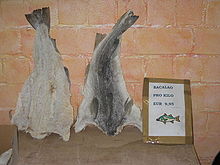
Trapped in a tiny room together, hungry, cold, and afraid, the world momentarily becomes a brighter place when Ma miraculously produces a frozen salted cod. “By George, Caroline, nothing can beat the Scotch!” exclaims Pa, in a rare allusion to Ma’s heritage.This brief ray of sunshine is soon ended, as the endlessly grinding mill goes on (what would they have done without the coffee mill?!) and Laura comments that Carrie is thin, white and exhausted and she is worried about her. The winds whirl and shriek at the lonely houses, whirling as the coffee mill goes ’round and ’round, “whirling forever over the endless prairie.”

Posted in Uncategorized Tagged with:

The Long Winter, Chapter 23: The Wheat In the Wall

We wake up to find the cozy tunnel gone, the snowdrifts scoured (again with that word, which I didn’t realize how evocative it was until Wendy brought it up) down to the bare ground.

We also find out it is the middle of February. (Ma answers the question that Laura asks “stupidly.”) Just two chapters ago we learned the train wasn’t going to come at all; that was in January. Since then the family has been subsisting on brown bread and potatoes and warming themselves with quick-burning hay fires.

Now things are getting raw. Laura deigns to interpret a remonstration from Ma (“Never complain of what you have. Always remember you are fortunate to have it”) as an indicator that the family might … starve? No, Ma tells her. If the family has to, they’ll kill and eat the stock. She shushes Laura who audibly protests; the girls are coming downstairs.

Pa goes to Fuller’s and comes back with a rumor: a settler south of town (“18 or 20 miles southeast of here”) has wheat. Foster, that troublemaking rascal, is behind the rumor. But it just might be true. Pa bandies about the idea of trying to find the guy—

–NO. Ma says, quite simply, not just no but hell no. Surprised by her intensity, Pa tries to talk to her but she’ll hear no more about it. Now comes my favorite use of italics in the series:

You don’t go hunting for that wheat.

Italics usually imply emphasis. Sometimes they represent volume. These italics indicate neither of these. It’s just Ma: “She was quiet but she was terrible.”

As a parent, I often long for Ma’s mastery of quiet and terrible.

Pa accepts her answer. He has no choice. But Ma’s outburst has rattled her; she spills the tea she’s pouring for Pa.

After doing the chores Pa inquires about the state of the wheat and the potatoes. Inside the folded-over, nearly empty sack, there’s wheat enough for the breakfast bread, and only six potatoes remain. Pa asks for the milk pail. (Why doesn’t he know where the milk pail is?)

Now we’re down the street at Royal and Almanzo’s where they’re devouring another stack of ’Manzo’s famous pancakes. When Pa comes to the door they’re excited to see another human being, greeting him with fervor and offering him pancakes. Pa declines and asks about wheat to sell. Royal says they’re sold out and says hey, have some pancakes anyway. Pa ignores him and steps over to the wall, removes the saddle and pulls the plug to fill his milk pail with wheat kernels. Almanzo is astounded and mightily protests as Pa calmly continues; Royal is amused, tipping “his chair back against the wall,” hands in his pockets, grinning at his brother.

When the pail’s full, “Pa thrust the plug into the hole.” Oh dear. Where’s Ann Romines when you need her?

Pa calmly explains to a dumbfounded Almanzo how he did the math and decided the inside of the room didn’t fit the outside. “I figured you had grain there. It’s the only thing likely to run out of knothole.”

Talk of Almanzo’s seed wheat leads to a discussion of the phantom wheat in some settler’s shanty outside town. Royal tells Pa he shouldn’t go: “Who’d take care of your folks if you got caught in a storm and …” – I love this, how he talks with an ellipsis – “got delayed or anything?”

Pa puts that aside and asks again for a price on his pailful of wheat. Almanzo tries to give it away, which Pa refuses. They settle on a quarter.

Then they all sit down to pancakes and sugar-cured ham. I was surprised to read how many of you thought Pa was being selfish eating the pancakes while his family was down the road, starving. I’ve always been relieved reading this, knowing that Pa is getting such a good meal. He worked so hard in such physically demanding conditions to provide for his family, all day, every day, and I’ve always been heartened to think of this extra nutrition he got to help him along. Thank you, Wilder boys!

Pa makes it home just as the next blizzard strikes. He shows Ma the wheat and she gratefully and wondrously strokes the kernels (calling to mind, for me, the baby chicks she strokes in the dark in Little Town). Pa tells her he can’t say where he got it, but “there’s more where that came from.”

Imagine Laura Wilder, over seventy years old, writing about her nineteen-year-old future husband’s wheat saving her family from starvation. (Or at least from killing their stock.) How much of the drama was real? How much was manufactured to fit comfortably into the story? We’ll never know, but I like the idea of her ruminating over this and deciding what to share with the world about the man she loved—or the boy she fell in love with.

Posted in Uncategorized Tagged with:

Crosswise Letter Writing, Mary Dislike, and Generic Chapter Titles

Before I launch into the chapter summary, I’d like to address a few things from “Fair Weather“:

Did anyone catch the reference to Ma writing her letter? She writes it horizontally, the way one normally writes a letter, and then she rotates the paper and writes “crosswise” right over the sentences she’s already written, these new sentences perpendicular to the others. I never understood what this meant until I saw an example of it in the museum at Mansfield. Talk about recycling!

The Polar and Tropical Worlds

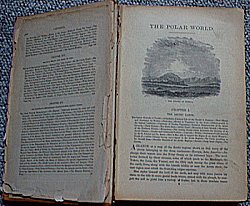
This chapter also marks the only time in the series I genuinely dislike Mary. “What a dreadful idea,” she says when poetic Laura suggests that the existence of the houses ruin the brilliance of the winter prairie. “We’d freeze to death.” When Laura gallantly offers to build her an igloo, saying they’d “live like Eskimos,” (no doubt pulling this knowledge from Pa’s “big green book,”  The Polar and Tropical Worlds, not “The Wonders of the Animal World” as Laura had remembered) her response is to shudder, “Ugh, on raw fish. I wouldn’t.” Well if you had nothing else to eat, Negative Nancy, you would! No go have your baked potato and tea.

One more general observation — I wonder if anyone of our readers shares it. As one of the administrators of this read-along, I’ve had occasion to match up chapter names with numbers, as well as the events within each chapter. And I’ve realized that of all the books in the Little House series, this book –The Long Winter—is the only one whose chapters don’t adequately describe the contents therein. Matching chapters to plot points is difficult.

If I were to say to you “Summer Storm,” or “Wheels of Fire,” or “Sugar Snow,” or “Wonderful Afternoon,” you’d likely be able to peg not only the book the chapters are pulled from, but a reasonable synopsis of the chapter as well. I can’t do this with TLW; the chapter titles are so generic. When I think of “Cold and Dark” and “The Hard Winter,” while I may be able to say that The Long Winter contains those chapters, I have no idea what’s in them. Only a few chapter titles are descriptive enough to recall the action within them.

“The Wheat In the Wall” is one of them. Coming up.

Posted in Uncategorized Tagged with:

The Long Winter, Chapter 22: Cold and Dark

By now the blizzards are coming to life in Laura’s dreams as monsters, as she sleeps to the sound of the ice-sand scouring the roof.  That scouring noise of the blizzards—a recurring description throughout the book—has always struck me as an unforgettable detail: it’s a sound that I imagine is practically foreign to us now that we live in more insulated homes.

Anyway, things are grim. Have the past few chapter summaries been saying that, too? Well, the grimness has progressed: the roof-nails have clumps of frost on them now; Laura and Pa’s hands are chapped and cut from twisting the hay sticks, and the rough hay has worn away their coats in the places where they held the bundles in place to twist them.  For breakfast the Ingallses eat the brown bread dipped in tea, and for dinner they have potatoes, which they divide carefully, letting Pa have the extra one to keep up his strength.

If only it had been that fair in real life: remember that recent post about that other family who lived with the Ingalls family during the Long Winter? Remember how George Masters was kind of a jerk? Yeah, he totally hogged the potatoes. In her unpublished “Pioneer Girl” manuscript, Laura writes that as the potato supply dwindled, George would help himself to them first (even though he wasn’t doing any chores because he considered himself a paying boarder). Reportedly he’d scarf them so fast he’d burn his mouth and then exclaim, “Potatoes do hold the heat!”  a phrase that eventually became an in-joke in the Ingalls family denoting selfishness. You really can’t blame Laura for writing him out of The Long Winter and rationing the fictional potatoes to favor Pa.

During the day, Ma rallies the girls by encouraging them to recite speeches and verses from the Independent Fifth Reader (thank goodness they have something else besides Millbank, though I suspect Laura can recite that book, too), and Pa hauls loads of hay.  Then one day comes a “still morning” when Laura comes downstairs and Pa shows her the tunnel of snow he’s dug from the lean-to door to the stable.

That’s right, folks: the house is buried in the snow. Laura runs upstairs and looks out the window and sees Main Street at eye level, and watches the hooves of the Wilder boys’ horses as they trot by.  As a kid, this part was amazing to me—perhaps even more so because the Blizzard of ‘79 in Chicago was a recent memory, and while that winter hadn’t produced snow that was deep enough to bury the first floor of a house, it helped me understand that such things were possible. (How did the children of De Smet resist going sledding off their own rooftops? Oh, I guess they probably couldn’t get outside.)

For once, the snow and the cold are respites: the kitchen is insulated by the deep snowdrifts, and the cold holds the tunnel in place.  The wind doesn’t blow, and for two days everything feels strangely quiet.

Then another storm sets in, and both Pa and Ma lose it for a moment—Pa curses the “gosh dang blizzard,” which “only lets go long enough to spit on its hands,” and Ma snaps back at him for swearing.

More coping and more bibilotherapy. This time Pa reads aloud from big green book of animals by the light of the button lamp.  But Laura can’t quite escape into the words this time, because the relentless winds and the numbing routines are taking their toll on her.  Suddenly she interrupts Pa’s reading and asks him to play the fiddle. Good idea!

Oh, but maybe it isn’t. The fiddle is brought out, and Pa attempts a few bars of “Bonnie Doon,” but his playing is off—his fingers, he says, are too stiff and thick from the cold to play properly.  It’s one of the very lowest points of the family’s endurance—the music is gone, Pa is embarrassed he can’t play, and Laura feels awful for asking him to play.  At least there is wheat to grind—as wearying as the routine is, the preparation of the daily bread gives the family something to do.  Pa goes out to do his chores (yet again), and Ma sits by the stove and sings a hymn to the girls.

Posted in Uncategorized Tagged with:

The Long Winter, Chapter 21: The Hard Winter

Guest post by Barbara Mayes Boustead

The chapter begins on a hopeful note, on a day full of sunshine.  After the day’s chores, Pa heads across the street to hear the news.  He returns with 4 pounds of ox meat to supplement the family’s diet.  He has spent a fair amount on it, purchased from Foster at 25 cents per pound.  Surely he makes this extravagant purchase knowing the impact of the news that he heard in town, knowing that he must think of how the Ingalls family will continue to eat through the winter.

Pa reluctantly shares the news that the trains will not be running for the rest of winter.  Ma, somewhat uncharacteristically though certainly understandably, freaks out just a bit, fretting how they are going to live through spring without trains.  As in the good old days in the Big Woods, Pa spins a parable for the girls, weaving an entertaining tale that also teaches a moral lesson.  He also uses the story to make light of a rather bleak situation.  The story of the train superintendent evokes a lesson of the patience and perseverance needed to live in the West.

Men working on Kelly's Cut near Sleepy Eye, MN, March 1881. Courtesy of Chicago & Northwestern Historical Society Archives.

The series of blizzards has kept the train tracks covered in snow, with snow blowing into the cuts to the top of the last snow accumulation.  With little time between storms, crews have been unable to clear the tracks on the Chicago & Northwestern line, and trains have been unable to run.  The superintendent arrives from The East to figure out for himself how to keep the trains running.  Pa does give credit to the man for being willing to do the work he asks of his employees.  He takes over the operation, culminating in an attempt to ram a locomotive through an icy drift.

Was the superintendent wrong to give up?  Was there any method, any amount of “stick-to-itiveness” that would have opened the tracks?  Without modern technology, relying on shovels, picks, and steam-powered locomotives, the Chicago & Northwestern train company (and the settlers helping out) might not have had the tools to keep up with the weather.  Perhaps the superintendent opted to not risk the lives of his employees to spin their wheels on a fruitless task.  Or, perhaps he got frustrated and threw in the towel after his brightest idea didn’t work.

The train has not passed through De Smet since late December, and it will not return for about another three months.  Pa indicates that they “only” have to get through the rest of January and all of February, expecting spring to arrive in March.  Again, foreshadowing rears its head in the form of optimism, as winter conditions actually continued through April.  There will be no re-supplying the town.

Laura is mature enough to be aware that the current stores of food at the Ingalls house are not adequate.  With a squeeze of her arm from Pa, she understands that she must “stand by” Pa and Ma, setting an example of cheeriness for the rest of the family.  She leads the girls up the stairs with a song, then as a blizzard strikes, ponders the loneliness of the town, and each house in it.

Posted in Uncategorized Tagged with: