Rose’s Legacy

We often refer to the “Little House” books as being Laura’s legacy… but what about the legacy of her daughter, Rose Wilder Lane?

The Libertarian Legacy of Rose Wilder Lane is a fascinating read, particularly for those attempting to understand the strong political beliefs of Laura’s daughter, and the complete about-face she made from calling herself a Communist to becoming instrumental in the formation of the Libertarian movement.

Also discussed is the role of Roger Lea MacBride, whom Laura’s readers know as the heir of the “Little House” legacy, in the Libertarian movement.

I remember Roger once saying, just a couple of years before his 1995 death, that Rose had left him a list of things to accomplish after her death. He stated then that he had completed nearly all of them. I’d love to see that list — but reading this article might give us a clue as to some of the things on it, for I’m sure many of them were political in nature. Rose certainly wanted Roger to carry on her political work.

And he did.

Posted in Uncategorized Tagged with:

The Long Winter, Chapter 33: Christmas In May

[Edited to add: I’m so sorry! I did not credit Laura Welser with writing this wonderful post. -Sandra]

Guest post by Laura Welser

I remember, like it was yesterday (and, believe me, it wasn’t!), the very first time I read this book. When I came to these last few chapters, I couldn’t help but feel joy and relief along with the family. The long, hard winter was over and they survived! Life would go on and they were ready to celebrate with their good friends, the Boasts.

Pa brought groceries that afternoon – that’s how the chapter begins. That one sentence says it all. Food and kerosene aplenty. It must have been the most wonderful sight to see him come home with his arms loaded with all of the things that they had been going without for all of those cold, hungry months.

Everything in Laura’s descriptions just sounds happier. Their first meal after Pa brought the groceries –”At suppertime the light shone through the clear glass onto the red-checked tablecloth and the white biscuits, the warmed up potatoes, and the platter of fried salt pork.” A simple meal, but in an entirely different environment.

It was truly going to be a Christmas celebration. They were all in the Christmas spirit as they spent the day preparing the feast that would take place the following day. It’s all about the food! Bread was rising, real bread. Dried apples and raisins to make pies. The cranberries were stewed until they were a mass of crimson jelly.

“It seems strange to have everything one could want to work with,” said Ma. And so she made a cake.

At the end of the day there was white bread, a cake, three pies and jellied cranberries. It must have been so difficult not to dig in! After Laura and Mary lightly argue (that same old argument) about the stuffing and how impatient they are to eat all of this good food, Ma tells them that they will have light bread and cranberry sauce for dinner. What seems like a insubstantial meal to many of us was a feast to the Ingalls family!

The next day could not come soon enough. As they prepared the turkey, Laura describes how the prairie smelled of springtime, how the doors were open and they could use both rooms once again. It gave her a spacious and rested feeling. All was right. Oh! How wonderful that turkey must have smelled!

The Boasts arrive. “For the last mile, I’ve been following my nose to that turkey!” Mr. Boast declared. After one of my many subsequent readings of this book, I wondered how many other folks in town wish they had been invited to the Ingalls’ for Christmas in May. Mrs. Boast is thin and had lost the lovely rosy color from her cheeks, but she is the same darling Mrs. Boast. It makes one wonder how they had survived the winter out on their claim shanty, even though they were much better off than most.

As Laura and Ma finish dinner preparations, Laura finds a mysterious package. Butter! The Boasts have brought butter. Their dinner is complete.

“Lord, we thank Thee for all Thy bounty.” That was all Pa said, but it seemed to say everything.

And they feast! Turkey, stuffing, mashed potatoes and gravy, cranberries, and bread and butter! The plates are filled, and then filled again. Then the pies and the cake are brought out. Everyone talks of the winter that they will try to put behind them and of the summer quickly approaching. They finally leave the table (and the clearing until later) and go sit by the sunny window. Sunny!

Then comes the moment that is a perfect close to this chapter, and this book:

Pa stretched his arms above his head. He opened and closed his hands and stretched his fingers wide, then ran them through his hair till it all stood on end.

“I believe this warm weather has taken the stiffness out of my fingers,” he said. “If you will bring me the fiddle, Laura, I’ll see what I can do.”

And Pa plays his fiddle once again.

And as they sang, the fear and the suffering of the long winter seemed to rise like a dark cloud and float away on the music. Spring had come. The sun was shining warm, the winds were soft, and the green grass was growing.

(Pa plays and they all sing — Where There’s a Will There’s a Way – Harry Clifton 1867. I love the lyrics.)


Posted in Uncategorized Tagged with:

Homesteader Price Is Going Up

With spring well in session, plans are coming together for the 18th issue of the Homesteader. That’s nine years of newsletters, two per year. And I’ll tell you something. I’ve loved putting together every single one.

Ever since I attended my first Laura Ingalls Wilder conference in 2001 in De Smet, I’ve known that this was what I was supposed to be doing — sharing what I’ve learned about Laura with fans just as devoted as I am. I love writing, I love Laura, and I love writing about Laura. Giving other people a chance to write about Laura comes in a close second. We all have so much to say. There’s never a shortage of story ideas, or fellow fans to share what they know or wonder about.

The Homesteader comes out twice a year

Since the Homesteader’s inception in summer 2002, we have been trying to keep subscriptions affordable. We like to print in color on high-quality paper; we think photographs are an essential component to the telling of any story about Laura. But printing costs have been inching up. Mailing costs have downright exploded — and continue to do so. Until now, we’ve kept prices the same as when we began, trying instead to be creative in savings in other areas. In 2007, based on feedback from subscribers, we started letting readers bind their own issues (sending these instructions out with each order) to save on labor costs without having to raise prices.

But the time has come. Our rising costs are forcing us to raise prices for the first time in eight years.

The new prices will go into effect after the upcoming issue  (Issue 17, Summer 2010) is printed. If you’ve been planning to order or renew your existing subscription, save yourself some money and do so now to take advantage of current pricing.

Posted in Uncategorized Tagged with:

The Long Winter, Chapter 32: The Christmas Barrel

This chapter is full of images that have stayed with me ever since my first reading of The Long Winter. To me, they’re full of burgeoning excitement.

Image 1: Pa and Mr. Boast walking down the street with the Christmas barrel between them.

Image 2: The family standing around the barrel waiting to see what’s underneath that brown paper.

Image 2: The “silk shawl!” Which Ma, fittingly, gets.

Image 3: The bright yarns and embroidery silks juxtaposed against Laura’s rough, hay-bitten fingers.

Image 4. The cranberries thumping and rolling around on the bottom of the barrel when Pa lifts up the turkey.

Mr. Boast has witnessed the festivities and runs home to tell Ellie that day after tomorrow (because the turkey needs to thaw, no doubt) will feature turkey at the Ingalls home for Christmas dinner – Christmas in May.

Posted in Uncategorized Tagged with:

Dean Butler’s LIW Documentary

Remember Dean Butler’s Legacy Documentaries’ biopic about Laura Ingalls Wilder?

It’s ready.

Here’s the trailer.

Posted in Uncategorized Tagged with: , ,

The Long Winter, Chapter 31: Waiting for the Train

Guest post by Barb Mayes Boustead

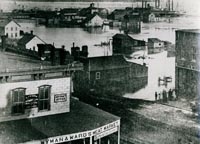
Flooding in Yankton, South Dakota, Spring 1881

Spring is here! Those of us who live on the Plains know the sense of relief all too well, how feeling mild temperatures and seeing green growth lifts the spirits. Warm weather arrived abruptly in mid-April after the last snow. Yet the town still waits for the trains, as manpower combines with nature to clear the snow and ice from the tracks. The snow has compacted, melted and refrozen, into a glacial pack that would take weeks to melt if left undisturbed.

Flooding in Mankato, Minnesota, 1881

To make matters worse, all of that melting snow has to go somewhere –- again, something well known by those of us in the Plains and upper Midwest this year – and the fields and roads are flooded. In fact, the flooding following the Hard Winter of 1880-81 was as historic as the winter itself, with many towns along the larger rivers like the Missouri, Red, and even the Mississippi experiencing record floods due to both ice jams and snow melt. Many of the record crests from 1881 still stand today, and many towns along these rivers suffered extensive damage; in fact, several towns either moved their sites or were wiped out altogether. But I digress! Here in DeSmet, the main impact of the flooding is to prevent transportation of supplies over land, emphasizing their reliance of the stalled rail system.

Flooding in Omaha, Nebraska, 1881

The winter has been hard on not only the health of the Ingalls family, but also their shelter, as the tar paper on the claim shanty has been shredded. Like so many other aspects of DeSmet life, repairs are stalled until the train can arrive with building supplies. To aid in clearing the way for the trains, Pa and other men in the area have been working to clear a smaller cut in between them and the still-stalled work train. He works until he shakes. Meanwhile, the family ekes out its meals from the last of the seed wheat. Supplies run low enough to scare Carrie into wondering if the family will be forced to eat newly sprouted grass to survive. (Perhaps her malnourished body is craving vegetables?)

Pa’s joke with Carrie about the grass has always intrigued me, standing out a bit from the rest of the dialogue. Nebuchadnezzar? When I read the book for the first time, sometime around age 9 or 10, I had to look that up… both the pronunciation and the meaning behind the allusion. I wonder if Pa is referring to the Hanging Gardens of Babylon, that Carrie won’t have to eat her way through the sprouting plant life. But Pa makes the joke with Carrie as a mere 10-year-old herself, and apparently, she gets it without having to look it up. It’s interesting what kids had learned at earlier ages back in the day. *

The morning of April 30 has a Christmas-like feel for the family, as the girls scramble to get ready (“Wait up, Laura, I can’t find my stockings!”) and Laura sings her way down the stairs. But they’ve all forgotten about the Superintendent’s stuck train, and it is this and not a freight train that passes through. Mr. Woodworth, the depot manager, breaks into the train to ration whatever goods he can find in the train, likely with the aid of several men who were expecting to supply their families that day. Pa bends his moral code to take some of the supplies home to his family, knowing they ate the very last of the seed wheat just that morning. It’s not enough to resupply the town, but it is enough to fortify the family supplies and break the wheat bread diet. Ma protests, but only mildly before she sets out to cook a proper meal for her family.

*Editor’s note: The “No, Nebuchadnezzar!” joke is in reference to the story of King Nebuchadnezzar in the book of Daniel. Nebuchadnezzar was proud and believed he was a great ruler all on his own, and although warned to repent, he did not, and as a result, was punished by going mad for seven years, during which time he actually ate grass!! When the seven years was up, his sanity was restored and after that he gave God the credit for making him a great ruler. So Pa was teasing Carrie by calling her Nebuchadnezzar for suggesting they eat grass, like he did. It’s a relatively minor story so it’s not surprising that many would not get the joke unless very familiar with Old Testament history, but as a Christian school kid, I knew it even as a child and got the joke then, so it’s reasonable to me that the Ingalls girls, having been raised with an emphasis on Bible reading, study, and memorization, would also have understood the reference, even at Carrie’s age of 10. ~Rebecca Brammer

Posted in Uncategorized Tagged with:

Little House Cooking in the NYT

I love when The New York Times goes Little House, especially in an I-thought-I-hated-these-books-but-look-how-cool-this-part-is way. “Little House in the Hood” is a rather interesting story from the NYT Magazine — a cooking column, actually — that references Little House in the Big Woods‘ butchering, ultimately drawing comparisons to today’s back-to-basics food trends in contemporary Brooklyn. And a big shout-out to Barbara Walker, author of the Little House Cookbook.

Posted in Uncategorized Tagged with: , ,

Great Discussion a Few Chapters Back

One of the limits of this blog is that truly organic discussions, no matter how pertinent or thoughtful, can so easily get left behind. I’d love to explore an alternative to comments that would keep discussions dynamic, interesting, and front-and-center. In the meantime, I’ll take a moment to point you back to the synopsis of Chapter 27, For Daily Bread. We’re up to 22 comments now. If you haven’t weighed in or seen what your fellow Little House fans have to say, you’re missing some pretty thoughtful discussion.

A lot of the discussion revolves around Cap Garland. A commenter tried unsuccessfully to post a link to a Cap Garland web site; I suspect it’s probably this one.

Posted in Uncategorized Tagged with: , ,

The Long Winter, Chapter 30: It Can’t Beat Us

It seems like it should be the end, but it’s not. The wheat has come in to “save” the town, but it’s not over yet. All the wheat means is that the townspeople have bread to eat instead of nothing to eat.

So many times when I think of The Long Winter, I recall this one paragraph:

In the morning Laura got out of bed into the cold. She dressed downstairs by the fire that Pa had kindled before he went to the stable. They ate their coarse brown bread. Then all day long she and Ma and Mary ground wheat and twisted hay as fast as they could. The fire must not go out; it was very cold. They ate some coarse brown bread. Then Laura climbed into the cold bed and shivered until she grew warm enough to sleep.

This chapter feels desolate and all but hopeless. Winter’s still here. Pa does not sing. The girls don’t have any lessons. They twist hay and eat bread. March ends. April begins. The blizzard is still there. Now it has become one blizzard, one storm. It takes longer breaks now—four days, even—but it always comes back.

When Pa says it’s thanks to Laura that the hay is holding out for fuel, we recall the hot days of haying last summer. Like Christmas in July, it seems unfathomable.

“Can’t it, Pa?” Laura asks when Pa says the storm cannot beat them. No, he repeats. We won’t give up. A small flame lights in Laura. It won’t give up either.

Then in the night, Laura hears the wind. It’s a different, wet wind. It doesn’t howl. It’s dripping. It’s the Chinook! The Chinook, the wind of spring!

Laura calls out to Pa. “The Chinook is blowing!”

Next morning everyone is happy. Mary pushes her chair back from the fire, saying it was too warm, bringing us to one of my favorite Little House one-sentence paragraphs:

How marvelous it was that anyone could be too warm.

Pa makes fun of Laura for yelling that the wind was blowing in the middle of the night. “As if the wind hadn’t blown for months!”

But it was the Chinook, Laura said. “That makes all the difference.”

Posted in Uncategorized Tagged with:

The Long Winter, Chapter 29: The Last Mile

This chapter is pivotal in more than one way, and there’s so much said in just a few pages that to attempt to expound upon it all would be quite challenging. So I’ll just make a few comments, and let you all hash out the rest of it.

First, we pick up with the last frightening mile of the wheat journey, after the pause the last chapter created which only served to build tension in the first-time reader. Will Cap and Almanzo return safely to the town with the much-needed wheat, or will they perish in the blizzard that is chasing them across the prairie?

Laura has an amazing talent for causing the reader to feel intense emotions while the characters themselves remain seemingly nonchalant. “We’re in for it now,” is the most Cap or Almanzo either one have to say about the perilous situation they find themselves in.

When the two men do make it to town safely with the wheat, the reactions of the others are similarly dispassionate. Look at Loftus’ reaction. No rushing to the door to greet him, no excited reaction, no rejoicing that they made it back safely. He merely stands and says,  “So you boys made it; we figured you hadn’t.” And within seconds, his only emotion concerns the price that was paid for the wheat!

We know Loftus is somewhat of a scoundrel in this chapter, so could pass his reaction off as part of his character, but Royal’s reaction is pretty similar, and this is his own brother he must certainly have believed to be lost in the storm.

The motives behind the trip for each of the boys also come out a little more in this chapter. Almanzo tells Prince he saved the seed wheat. Clearly, Almanzo had no intention of letting people starve while he had wheat that could have saved their lives. This wasn’t about saving lives; those he would save regardless. It was about saving his wheat. His opportunity for future success, prosperity. It’s the “Farmer Boy” in his blood showing itself.

Cap says they made the trip for the fun of it. I would venture to guess that Cap’s family probably was in need of the food, and he likely made the trip at least in part for that purpose. But with a personality like Cap’s, I can’t imagine but that the adventure and danger of the trip is what made it so enticing for him.

I won’t make any political comments regarding what happens next — the scene where Loftus charges exorbitant rates for the wheat and Pa negotiates a better rate, and then the scene where the townspeople avoid a frenzied free-for-all and come to a fair distribution of wheat, by their own choice, willingly, not mandated by any leadership. But there are certainly plenty of conclusions to be drawn from this, and each reader may have a different interpretation of those, based on their own worldview and political thoughts. I’ll let you guys fight it out in the comments. :)   (Respectfully, of course!)

But no matter whether you agree with others’, or with Laura’s (or Rose’s) viewpoints or political beliefs, I think everyone will agree that this chapter, particularly these two final scenes, are nothing short of genius. If Laura is deficient in anything, it certainly isn’t critical thinking, logic, and reasoning skills.

This chapter is also the turning point of the book. Up until now, the overall theme has been survival, and the prospect has looked bleaker and bleaker as the winter has stretched on, and the food has run thin. Just this morning, the Ingalls family ate their final meal. If Cap and Almanzo had not returned with that wheat, there would be far more at stake for Laura and the family than the loss of these two outstanding young men.

But they did return, and at long last, we end a chapter on a positive hopeful note. That two bushels of wheat changes everything. Now for the first time since learning that there will be no trains till spring, there is hope.

They WILL survive this winter.

Posted in Uncategorized Tagged with: